Labels

SUPPORT JULIAN ASSANGE

Thursday, October 4, 2018

DE -- Manlio Dinucci -- "DIE KUNST DES KRIEGES" -- DIE POLITISCHE MACHT DER WAFFEN


"DIE KUNST DES KRIEGES"
Die politische Macht der Waffen
von Manlio Dinucci

Europäische Märkte und Union in Alarmbereitschaft, Opposition im Angriff, eine Erinnerung an die Verfassung durch den Präsidenten der Republik, all dies, weil das von der Regierung geplante und bereits angekündigte Finanzmanöver zu einem Defizit von etwa 27 Milliarden Euro führen würde. Auf der anderen Seite, absolutes Schweigen von Regierung und Opposition zu der Tatsache, dass Italien jedes Jahr einen vergleichbaren Betrag für seinen Militärhaushalt ausgibt.
Die Militärausgaben für 2018 belaufen sich auf rund 25 Milliarden Euro, zu denen noch weitere Posten mit militärischem Charakter hinzukommen müssen, so dass die Gesamtausgaben auf mehr als 27 Milliarden Euro steigen. Das bedeutet mehr als 70 Millionen Euro pro Tag, was noch mehr wird, da Italien der NATO versprochen hat, auf etwa 100 Millionen pro Tag zu erhöhen.
Warum spricht niemand von den steigenden Ausgaben öffentlicher Gelder für Waffen, Streitkräfte und militärische Interventionen? Denn das würde bedeuten, dass man sich den Vereinigten Staaten, dem "privilegierten Verbündeten" ("betont" gelesen), widersetzt, der eine kontinuierliche Erhöhung dieser Ausgaben verlangt.
Die Ausgaben der USA für ihre Streitkräfte im Geschäftsjahr 2019 (das am 1. Oktober 2018 begann) übersteigen 700 Milliarden Dollar, zu denen weitere militärische Kosten hinzukommen, darunter fast 200 Milliarden für pensioniertes Militärpersonal. Die gesamten Militärausgaben der Vereinigten Staaten sind damit auf mehr als 1.000 Milliarden Dollar jährlich angestiegen, ein Viertel aller Bundesausgaben. Eine zunehmende Investition in den Krieg, die es den Vereinigten Staaten (gemäß der offiziellen Zielsetzung des Pentagons) ermöglicht, "die führende Militärmacht in der Welt zu bleiben, um sicherzustellen, dass das Kräfteverhältnis zu unseren Gunsten bleibt, und um eine internationale Ordnung voranzubringen, die unseren Wohlstand auf das Maximum fördert".
Aber im Geschäftsjahr 2019 werden die Militärausgaben ein Defizit von fast 1.000 Milliarden Dollar im Bundeshaushalt verursachen. Später wird dies zu einem Anstieg der Schulden der US-Regierung auf rund 21.500 Milliarden Dollar führen. Dies wird im Inneren durch Kürzungen der Sozialausgaben und im Außen durch den Druck von mehr Dollar absorbiert, die als Hauptwährung der Weltwährungsreserven und der Notierungen für Rohstoffe dienen.

Von den erhöhten Militärausgaben profitiert jedoch niemand. Wir haben es hier mit den Giganten  der Rüstungsindustrie zu tun. Von den zehn größten Waffenherstellern der Welt sind sechs US-Unternehmen:  Lockheed Martin, Boeing, Raytheon Company, Northrop Grumman, General Dynamics und L3 Technologies. Es folgen das britische Unternehmen BAE Systems, das französisch-niederländische Unternehmen Airbus, das italienische Unternehmen Leonardo (ex-Finmeccanica), das nun auf Platz neun liegt, und das französische Unternehmen Thales.
Das sind nicht nur riesige Fabriken, die Waffen produzieren. Zusammen bilden sie einen militärisch-industriellen Komplex, der eng mit Institutionen und Parteien verbunden ist und tiefe und weitreichende Auswirkungen hat. Dies schafft eine echte Rüstungsindustrie, deren Gewinne und Mächte mit zunehmender internationaler Spannung und Krieg zunehmen.
Leonardo, das 85 % seiner Gewinne aus Waffenverkäufen erzielt hat, ist in den militärisch-industriellen Komplex der USA integriert - es liefert Produkte und Dienstleistungen nicht nur an die Streitkräfte und Agenturen des Pentagons, sondern auch an US-Geheimdienste, während es in Italien den Standort Cameri für die F-35 von Lockheed Martin verwaltet.
Im September wurde Leonardo vom Pentagon mit Boeing als Hauptauftragnehmer ausgewählt, um die US-Luftwaffe mit AW139-Angriffshubschraubern zu versorgen. Im August lieferten Fincantieri (kontrolliert von der Finanzgesellschaft des Wirtschafts- und Finanzministers) und Lockheed Martin zwei weitere Küstenkampfschiffe an die US Navy.
All das müssen wir im Hinterkopf behalten, wenn wir uns fragen, warum es in den italienischen parlamentarischen Organisationen und Institutionen einen so überwältigenden, parteiübergreifenden Konsens gibt - nicht für die Kürzung des Haushalts, sondern für die Erhöhung der Militärausgaben.
Manlio Dinucci
Quelle : Il manifesto, (Italien)

Übersetzung: K.R.

NO WAR NO NATO
https://www.pandoratv.it/category/opinioni/manlio-dinucci-opinioni/


Manlio Dinucci


Geograph und Geopolitiker. Letztes veröffentliche Werk: Laboratorio di geografia, Zanichelli 2014 ; Diario di viaggio, Zanichelli 2017 ; L’arte della guerra / Annali della strategia Usa/Nato 1990-2016, Zambon 2016, Guerra Nucleare. Il Giorno Prima 2017; Diario di guerra Asterios Editores 2018

Wednesday, October 3, 2018

THIERRY MEYSSAN -- UNO : birth of the post-Western world

The administration of the UNO had been hoping for a clash between the pro- and anti-Trump factions during the General Assembly. What actually happened was very different. While several States, including France, denounced the methods of the resident of the White House, Russia undertook an analysis of the Western alliance. According to Moscow, most of our current problems are due to the desire of the old colonial powers to conserve their domination of the rest of the world - at whatever the cost. In order to overtake them, a formidable coalition has been born.
 | DAMASCUS (SYRIA)  
JPEG - 77.2 kb
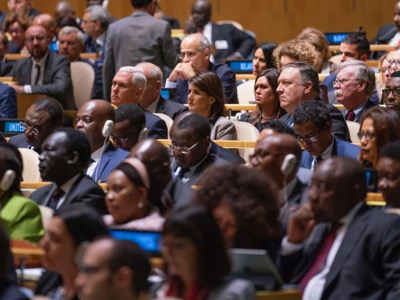
The hearing of the 73rd session of the United Nations General Assembly.
Despite appearances, the procession of the heads of State and government, or Ministers for Foreign Affairs, at the General Assembly of the United Nation was not without purpose. It’s true that most of them, having little to say, addressed their interior public opinions by blaming UNO incompetence and calling for a respect for the law. But many of their interventions went straight to the heart of the matter – how to resolve the disputes between States and guarantee peace?

Tuesday, October 2, 2018

EN -- Manlio Dinucci -- « THE ART OF WAR » -- THE POLITICAL POWER OF WEAPONS


« THE ART OF WAR »

The political power of weapons


by Manlio Dinucci


European Markets and Union on alert, opposition on the attack, a reminder about the Constitution by the President of the Republic, all this because the government-planned financial manoeuvre, which has already been announced, would lead to a deficit of about 27 billion Euros. On the other hand, absolute silence from the government and the opposition about the fact that every year, Italy spends a similar sum for its military budget. Military spending for 2018 is approximately 25 billion Euros, to which must be added other posts of a military character, bringing the total to more than 27 billion. This means more than 70 million Euros per day, which is on the increase because Italy has promised NATO to bring it up to about 100 million per day.

  • Why is no-one talking about the growing expenditure of public money for weapons, armed forces and military interventions?
Because that would entail opposing the United States, the « privileged ally » (read 'dominant'), which is demanding a continual increase of this spending.


US spending for its armed forces in fiscal year 2019 (which began on 1 October 2018) exceeds 700 billion dollars, to which must be added other military costs, including almost 200 billion for retired military personnel. The total military spending of the United States has thus grown to more than 1,000 billion dollars annually, a quarter of all federal expenditure. An increasing investment in war which permits the United States (according to the Pentagon's official motivation) to « remain the pre-eminent military power in the world, to ensure that the balance of power stays in our favour, and to advance an international order which favours our prosperity to the maximum ».But in fiscal year 2019, military spending will create a deficit of almost 1,000 billion dollars in the federal budget. 

Later, this will cause an increase of the US government's debt, rising to about 21,500 billion dollars. This will be absorbed in the interior by cuts in social spending, and, in the exterior, by printing more dollars, used as the principal currency of world monetary reserves and the quotations for prime materials. Some, however, benefit from increased military spending.We are dealing here with the giants of the war industries. Of the ten largest world producers of weaponry, six are US companies:

  • Lockheed Martin,
  • Boeing,
  • Raytheon Company,
  • Northrop Grumman,
  • General Dynamics,
  • L3 Technologies.

They are followed by

  • the British company BAE Systems,
  • the French/Dutch company Airbus,
  • the Italian company Leonardo (ex-Finmeccanica), now running ninth,
  • and the French company Thales.

These are not simply huge factories which produce weapons. Together, they form a military-industrial complex, closely integrated with institutions and parties, with deep and wide-reaching ramifications. This creates a true arms establishment, whose profits and powers increase as international tension and war increase.

Leonardo, which earned 85 % of its profits from arms sales, is integrated with the US military-industrial complex – it supplies products and services not only to the armed forces and agencies of the Pentagon, but also to US intelligences agencies, while in Italy it manages the Cameri site for Lockheed Martin's F-35 fighters. In September, Leonardo was chosen by the Pentagon, with Boeing as its primary contract employee, to supply the US Air Force with AW139 attack helicopters. In August, Fincantieri (controlled by the financial company of the Minister of the Economy and Finance) and Lockheed Martin, delivered two more littoral combat ships to the US Navy.

We need to keep all that in mind when we ask ourselves why, in Italian parliamentary organisations and institutions, there is such an overwhelming multi-partisan consensus - not for cutting into the budget, but for increasing military spending.

Il manifesto, October 2nd,  2018

Translator: Pete Kimberley

NO WAR NO NATO


Manlio Dinucci

Geographer and geopolitical scientist. His latest books are: Laboratorio di geografia, Zanichelli 2014 ; Diario di viaggio, Zanichelli 2017 ; L’arte della guerra / Annali della strategia Usa/Nato 1990-2016, Zambon 2016, Guerra Nucleare. Il Giorno Prima 2017; Diario di guerra Asterios Editores 2018. 

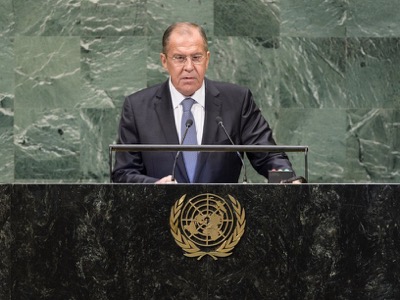
Remarks by Sergey Lavrov to the 73rd Session of the United Nations General Assembly

by Sergey Lavrov
VOLTAIRE NETWORK | NEW YORK (USA) | 28 SEPTEMBER 2018 
 JPEG - 44.9 kb
Distinguished Ms. President, 
Ladies and Gentlemen,
The statements at the general debate prove that international relations are going through quite a complicated and controversial historic period.
Today we all are witnessing a collision of two opposite trends. On the one hand, we see the strengthening of polycentric principles of the world order, the steady development of new centers of economic growth, the aspiration of peoples to preserve sovereignty and choose development models that are consistent with their national, cultural, and religious identities. On the other hand, we see the desire of several Western states to retain their self-proclaimed status of "world leaders" and to slow down the irreversible objective process of establishing multipolarity. To that end, these powers do not hesitate to use any methods, including political blackmail, economic pressure, and brute force.
These illicit acts devalue the international law which underpins the post-war world order. We hear loud statements that not only call into question the legal validity of international treaties, but also declare the priority of self-serving unilateral approaches over the decisions taken in the framework of the United Nations.
We observe the offensive of belligerent revisionism against the modem system of intemational law. The attacks have been launched against the basic principles of the Middle East settlement, the Joint Comprehensive Plan of Action on the Iranian nuclear program, the commitments within the World Trade Organization framework, the multilateral climate agreement ? and many more. Besides, our VI estern colleagues are persistently trying to substitute some type of a "rules based order" for the supremacy of law in the world affairs. These rules themselves are invented depending on political expediency and are an illustration of double standards. Baseless accusations of interference into internal affairs of certain countries are being made simultaneously with overt endeavors to undermine and topple democratically elected governments. Attempts are being made to draw certain countries into self-customized military alliances against the will of the peoples, while other states are threatened with punishment for their free choice of partners and allies.
It is indicative that aggressive attacks on intemational institutions are accompanied by attempts to "privatize" secretariat structures and grant them the rights of intergovemmental bodies in the hope to manipulate them later.
The shrinking space for constructive international cooperation, escalating confrontation, growing overall unpredictability, a substantially increased risk of spontaneous conflicts - all this affects the work of the World Organization.
The international community has to pay a high price for the parochial, selfserving ambitions of a small group of countries. The collective mechanisms of response to common security challenges have stalled. Diplomacy and the culture of negotiations and compromise have been increasingly replaced by dictate and unilateral extraterritorial restrictions put in effect without the consent of the UN Security Council. Such measures, applied already to dozens of countries, are not only illicit, but also ineffective - as exemplified, in particular, by more than half a century long US blockade of Cuba, which is condemned by the entire international community.
Yet, history does not teach any lessons. The number of those wishing to pass verdicts without charge or trial is not getting any smaller. Today assumptions in the spirit of the notorious "highly likely" are sufficient for some of our Western colleagues to press charges against anyone. We have already been through this.
We remember well so many times when spurious pretexts were used to justify interventions and unleash wars - as was the case in Yugoslavia 1999, Iraq 2003, and Libya 2011.

FR-- Manlio Dinucci -- L'Art de la Guerre -- LE POUVOIR POLITIQUE DES ARMES


L’art dela guerre
LE POUVOIR POLITIQUE DES ARMES 
Manlio Dinucci


Marchés et Union européenne en alerte, opposition à l’attaque, appel du Président de la République à la Constitution, parce que la manoeuvre financière, annoncée, du gouvernement comporterait un déficit d’environ 27 milliards d’euros. Silence absolu par contre, que ce soit dans le gouvernement comme dedans l’opposition, sur le fait que l’Italie dépense en une année une somme analogue dans un but militaire.  La dépense de 2018 est d’environ 25 milliards d’euros, auxquels s’ajoutent d’autres postes de caractère militaire en la portant à plus de 27 milliards. Ce sont plus de 70 millions d’euros par jour, en augmentation puisque l’Italie s’est engagée dans l’Otan à les porter à environ 100 millions par jour.
Ø  Pourquoi personne ne met-il en discussion le croissant débours d’argent public pour des armes, forces armées et interventions militaires ? 
Parce que cela voudrait dire se mettre contre les États-Unis, l’”allié privilégié” (c’est-à-dire dominant), qui nous demande une augmentation continue de la dépense militaire.
La dépense militaire étasunienne pour l’année fiscale 2019 (commencée le 1er octobre 2018) dépasse les 700 milliards de dollars, auxquels s’ajoutent d’autres postes de caractère militaire, y compris presque 200 milliards pour les militaires à la retraite. La dépense militaire totale des États-Unis grimpe ainsi à plus de 1.000 milliards de dollars annuels, soit un quart de la dépense fédérale. Investissement croissant dans la guerre, qui permet aux États-Unis (selon la motivation officielle du Pentagone) de “rester la puissance militaire prééminente dans le monde, assurer que les rapports de puissance restent en notre faveur et faire avancer un ordre international qui favorise au maximum notre prospérité”.
Mais la dépense militaire provoquera dans le budget fédéral, dans l’année fiscale 2019, un déficit de presque 1.000 milliards. Qui fera augmenter ultérieurement la dette du gouvernement fédéral USA, atteignant environ 21.500 milliards de dollars. Celle-ci se décharge à l’intérieur avec des coupes dans les dépenses sociales et, à l’extérieur, en imprimant des dollars, utilisés comme principale monnaie des réserves monétaires mondiales et des cotations des matières premières.
Mais d’aucuns sont gagnants dans la croissance de la dépense militaire. Ce sont les colosses de l’industrie de guerre. Parmi les dix plus grands producteurs mondiaux d’armements, six sont étasuniens :
·         Lockheed Martin,
·         Boeing,
·         Raytheon Company,
·         Northrop Grumman,  
·         General Dynamics,
·         L3 Technologies.
Suivent:
BAE Systems - britanique,  
 Airbus - franco-hollandais,
Leonardo (ex-Finmeccanica) – italian, désormais au 9ème rang,
Thales - français.

Ce ne sont pas seulement de gigantesques usines productrices d’armements. Elles forment le complexe militaro-industriel, étroitement intégré aux institutions et partis, dans un étendu et profond enchevêtrement d’intérêts. Cela crée un véritable establishment des armes, dont les profits et pouvoirs augmentent dans la mesure où augmentent les tensions et guerres. 
Leonardo, qui tire 85% de son chiffre d’affaires de la vente d’armes, est intégré dans le complexe militaro-industriel étasunien : il fournit des produits et services non seulement aux Forces armées et aux agences du Pentagone, mais aussi aux agences de renseignement, tandis qu’en Italie il gère le site de Cameri des chasseurs F-35 de Lockheed Martin. En septembre Leonardo a été choisi par le Pentagone, avec Boeing comme premier contractuel, pour fournir à l’U.S. Air Force l’hélicoptère d’attaque AW139. En août, Fincantieri (contrôlé par la société financière du Ministère de l’Économie et des finances) a remis à l’U.S. Navy, avec Lockheed Martin,  deux autres navires de combat en zone littorale.
Il faut garder tout cela à l’esprit quand on se demande pourquoi, dans les organes parlementaires et institutions italiens, se trouve un écrasant consensus multipartisan pour non pas couper mais augmenter la dépense militaire.


Edition de mardi 02 octobre 2018 de il manifesto

Traduit de l’italien par Marie-Ange Patrizio

Géographe et géopolitologue. Derniers ouvrages publiés : : Laboratorio di geografia, Zanichelli 2014 ; Diario di viaggio, Zanichelli 2017 ; L’arte della guerra / Annali della strategia Usa/Nato 1990-2016, Zambon 2016, Guerra Nucleare. Il Giorno Prima 2017; Diario di guerra Asterios Editores 2018.

Monday, October 1, 2018

PT -- Manlio Dinucci -- A Arte da Guerra -- O PODER POLÍTICO DAS ARMAS


A  Arte da Guerra

o poDER polÍtico dAS armAS

Manlio Dinucci

Os Mercados e a União Europeia estão em alarme, a oposição está ao ataque, a advertência do Presidente da República sobre a Constituição, tudo porque a anunciada manobra financeira do governo resultaria num déficit de cerca de 27 biliões de euros. No entanto, silêncio absoluto, tanto no governo como na oposição, sobre o facto de que a Itália gasta num ano uma quantia análoga para fins militares. A verba de 2018, é de cerca de 25 biliões de euros, à qual se junta outros elementos de carácter militar, elevando-a para mais de 27 biliões. São mais de 70 milhões de euros por dia, em expansão visto que a Itália se comprometeu com a NATO a elevar essa despesa até cerca de 100 milhões por dia.


  • Por que razão é que ninguém questiona a crescente despesa de dinheiro público com armas, com as forças armadas e com intervenções militares?

Porque isso significaria ficar contra os Estados Unidos, o “aliado privilegiado” (ou seja, dominante), que exige um aumento contínuo da despesa militar.

A despesa dos EUA para o ano fiscal de 2019 (iniciado em 1 de Outubro de 2018), ultrapassa 700 biliões de dólares, além de outros itens militares, incluindo quase 200 biliões para os militares aposentados. A despesa militar total dos Estados Unidos sobe para mais de 1 trilião de dólares por ano, ou um quarto da despesa federal. Um investimento progressivo na guerra, que permite aos Estados Unidos (segundo a motivação oficial do Pentágono) “permanecer a potência militar predominante no mundo, assegurar que as relações de poder permaneçam a nosso favor e fazer avançar uma ordem internacional que favoreça ao máximo, a nossa prosperidade”. No entanto, a despesa militar provocará um déficit de quase 1 trilião no orçamento federal, no ano fiscal de 2019.

Isso aumentará ainda mais a dívida do Governo Federal USA, que subiu para cerca de 21,5 triliões de dólares. Essa despesa incide no valor atribuído ao orçamento interno, com cortes nas despesas sociais e no orçamento externo, imprimindo dólares, usados como principal moeda das reservas globais e das quotizações das matérias primas. Mas há os que ganham com o aumento crescente da despesa militar. São os colossos da indústria bélica. Entre as dez maiores empresas fabricantes de armas do mundo, seis são americanas:

·         Lockheed Martin,
·         Boeing,
·         Raytheon Company,
·         Northrop Grumman,  
·         General Dynamics,
·         L3 Technologies.

Seguem-se:

·         BAE Systems - britânica,  
·         Airbus - franco-holandesa,
·         Leonardo (ex-Finmeccanica) – italiana que subiu para o nono lugar, e
·         Thales - francesa.

Não são, apenas, empresas gigantescas de fabrico de armas. Elas formam o complexo militar-industrial, estreitamente integrado nas instituições e nos partidos, num extenso e profundo entrelaçamento de interesses. Isto cria um verdadeiro ‘establishment’ das armas, cujos lucros e poderes aumentam, à medida que se expandem as tensões e as guerras.

A Leonardo, que recebe 85% da sua faturação com a venda de armas, está integrada no complexo militar-industrial USA: fornece produtos e serviços não apenas às Forças Armadas e às empresas do Pentágono, mas também para as agências de serviços secretos (br. Inteligência), enquanto, na Itália, admninistra as instalações da Cameri, dos caças F-35 da Lockheed Martin. Em Setembro, a Leonardo foi escolhida pelo Pentágono, como a primeira empresa contratante da Boeing, para fornecer à Força Aérea dos EUA o helicóptero de ataque AW139. Em Agosto, a Fincantieri (controlada pela sociedade financeira do Ministério da Economia e Finanças) entregou à US Navy, com a Lockheed Martin, mais dois navios de combate costeiro.

Tudo isto deve estar presente quando se pergunta por que motivo, nos órgãos parlamentares e institucionais italianos, há um acordo multipartidário esmagador em relação a não cortar, mas para aumentar, a despesa militar.


Il manifesto, 02 de Outubro de 2018

NO WAR NO NATO


Manlio Dinucci
Geógrafo e geopolitólogo. Últimas obras publicadas: Laboratorio di geografia, Zanichelli 2014 ; Diario di viaggio, Zanichelli 2017 ; L’arte della guerra / Annali della strategia Usa/Nato 1990-2016, Zambon 2016, Guerra Nucleare. Il Giorno Prima 2017; Diario di guerra Asterios Editores 2018. 

IT -- Manlio Dinucci -- L'Arte della Guerra -- IL POTERE POLITICO DELLE ARMI


L’arte della guerra

Il potere politico delle armi

Manlio Dinucci

Mercati e Unione europea in allarme, opposizione all’attacco, richiamo del presidente della Repubblica alla Costituzione, perché l’annunciata manovra finanziaria del governo comporterebbe un deficit di circa 27 miliardi di euro. Silenzio assoluto invece, sia nel governo che nell’opposizione, sul fatto che l’Italia spende in un anno una somma analoga a scopo militare. Quella del 2018 è di circa 25 miliardi di euro, cui si aggiungono altre voci di carattere militare portandola a oltre 27 miliardi. Sono oltre 70 milioni di euro al giorno, in aumento poiché l’Italia si è impegnata nella Nato a portarli a circa 100 milioni al giorno.
        
Ø  Perché nessuno mette in discussione il crescente esborso di denaro pubblico per armi, forze armate e interventi militari?

Perché vorrebbe dire mettersi contro gli Stati uniti, l’«alleato privilegiato» (ossia dominante), che ci richiede un continuo aumento della spesa militare. 


Quella statunitense per l’anno fiscale 2019 (iniziato il 1° ottobre 2018) supera i 700 miliardi di dollari, cui si aggiungono altre voci di carattere militare, compresi quasi 200 miliardi per i militari a riposo. La spesa militare complessiva degli Stati uniti sale così a oltre 1.000 miliardi di dollari annui, ossia a un quarto della spesa federale. Un crescente investimento nella guerra, che permette agli Stati uniti (secondo la motivazione ufficiale del Pentagono) di «rimanere la preminente potenza militare nel mondo, assicurare che i rapporti di potenza restino a nostro favore e far avanzare un ordine internazionale che favorisca al massimo la nostra prosperità». La spesa militare provocherà però nel budget federale, nell’anno fiscale 2019, un deficit di quasi 1.000 miliardi.

Questo farà aumentare ulteriormente il debito del governo federale USA, salito a circa 21.500 miliardi di dollari. Esso viene scaricato all’interno con tagli alle spese sociali e, all’estero, stampando dollari, usati quale principale moneta delle riserve valutarie mondiali e delle quotazioni delle materie prime. C’è però chi guadagna dalla crescente spesa militare. Sono i colossi dell’industria bellica. Tra le dieci maggiori produttrici mondiali di armamenti, sei sono statunitensi:

·         Lockheed Martin,
·         Boeing,
·         Raytheon Company,
·         Northrop Grumman,
·         General Dynamics,
·         L3 Technologies.

Seguono:

·         la britannica BAE Systems,
·         la franco-olandese Airbus,
·         l’italiana Leonardo (già Finmeccanica) salita al nono posto,
·         la francese Thales. 

Non sono Non sono solo gigantesche aziende produttrici di armamenti. Esse formano il complesso militare-industriale, strettamente integrato con istituzioni e partiti, in un esteso e profondo intreccio di interessi. Ciò crea un vero e proprio establishment delle armi, i cui profitti e poteri aumentano nella misura in cui aumentano tensioni e guerre.

La Leonardo, che ricava l’85% del suo fatturato dalla vendita di armi, è integrata nel complesso militare-industriale statunitense: fornisce prodotti e servizi non solo alle Forze armate e alle aziende del Pentagono, ma anche alle agenzie d’intelligence, mentre in Italia gestisce l’impianto di Cameri dei caccia F-35 della Lockheed Martin. In settembre la Leonardo è stata scelta dal Pentagono, con la Boeing prima contrattista, per fornire alla US Air Force l’elicottero da attacco AW139. In agosto, Fincantieri (controllata dalla società finanziaria del Ministero dell'Economia e delle Finanze) ha consegnato alla US Navy, con la Lockheed Martin, altre due navi da combattimento litorale.

Tutto questo va tenuto presente quando ci si chiede perché, negli organi parlamentari e istituzionali italiani, c’è uno schiacciante consenso multipartisan a non tagliare ma ad aumentare la spesa militare. 

il manifesto, 02 ottobre 2018


Manlio Dinucci
Geografo e geopolitologo. Ultimi lavori pubblicati: Laboratorio di geografia, Zanichelli 2014 ; Diario di viaggio, Zanichelli 2017 ; L’arte della guerra / Annali della strategia Usa/Nato 1990-2016, Zambon 2016, Guerra Nucleare. Il Giorno Prima 2017; Diario di guerra Asterios Editores 2018.

assange


At midday on Friday 5 February, 2016 Julian Assange, John Jones QC, Melinda Taylor, Jennifer Robinson and Baltasar Garzon will be speaking at a press conference at the Frontline Club on the decision made by the UN Working Group on Arbitrary Detention on the Assange case.

xmas


the way we live

MAN


THE ENTIRE 14:02' INTERVIEW IS AVAILABLE AT

RC


info@exopoliticsportugal.com

BJ 2 FEV


http://benjaminfulfordtranslations.blogspot.pt/


UPDATES ON THURSDAY MORNINGS

AT 08:00h UTC


By choosing to educate ourselves and to spread the word, we can and will build a brighter future.

bj


Report 26:01:2015

BRAZILIAN

CHINESE

CROATIAN

CZECK

ENGLISH

FRENCH

GREEK

GERMAN

ITALIAN

JAPANESE

PORTUGUESE

SPANISH

UPDATES ON THURSDAY MORNINGS

AT 08:00 H GMT


BENJAMIN FULFORD -- jan 19


UPDATES ON THURSDAY MORNINGS

AT 08:00 H GMT

PressTV News Videos