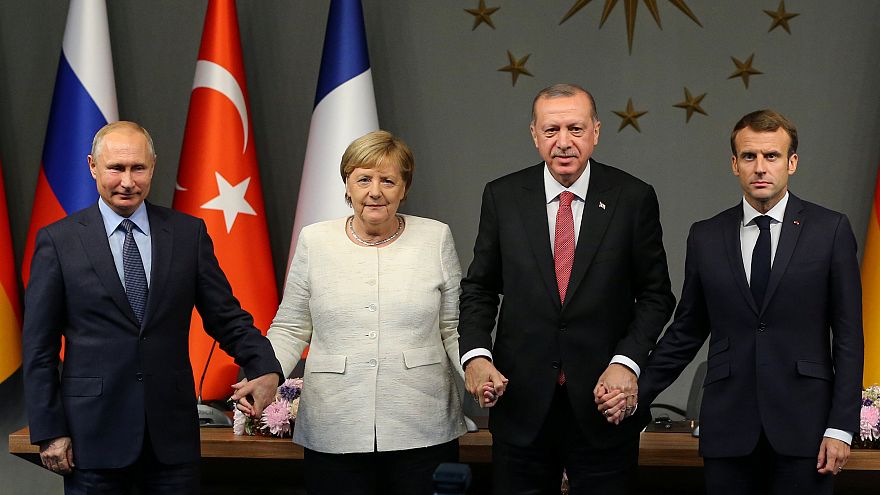
Unprecedented Summit of Four in
Istanbul reveals unbridged, irreconcilable differences between Russia and the
West over Syria
29 October 2018
The summit meeting of the German
chancellor and the presidents of Turkey, Russia and France in Istanbul this
past Saturday has rightfully been called “unprecedented” by the world press. It
was the first time Putin, Macron and Merkel sat together since the last G-20.
It was the first meeting of two very different groups of backers of a Syrian
settlement: the Astana Group, represented by Russia, and the so-called
Small Group, represented by France and Germany. But by a conspiracy of silence
its net results have been reduced by global media to the hopeful and empty
generalization that “the solution to the Syrian crisis can only be political,
not military” while the irreconcilable differences among the parties over how
to structure the political process and what it will lead to remain
unstated. Unstated not only by the French, German and Turkish media, but
also by the Russian media, for which I take last night’s News of the
Week with Dimitri Kiselyov on the state channel Rossiya-1 as my
marker.
In this brief essay, I will focus
precisely on the differing, essentially contradictory understandings of the
cause of the Syrian tragedy, of the legitimacy of the Syrian government
or ”regime,” and on the way that a political settlement can or cannot achieve
what was not achieved on the battlefield by the opponents of President
Bashar Assad.
My prime material for providing this
analysis is the full video broadcast of the press conference which the four
leaders held at the conclusion of their 3 hours of talks provided by Ruptly,
the German affiliate of RT and posted on youtube: https://www.youtube.com/watch?v=cezjdhuEd18
It bears mention that such
broadcasting is a very significant public service to the credit of RT and to
the shame of all the mainstream Western media that denigrate the Russian news
agency by calling it a propaganda outlet of the Kremlin. Full, uncut transmission
of major international events represents the best side of the
dis-intermediation that typifies our internet age. It allows each of us to draw
our own conclusions on what transpired based on what we hear and see, including
the body language of the leading personalities.
* * * *
Interpersonal Dynamics of the Four
Leaders
Putin
Before the summit, many commentators
spoke of the key role expected to be played by President Putin, for whom
sitting down together with Macron and Merkel to talk about a collaborative
approach to ending the Syrian crisis would appear to amount to a political
victory. Ever since the crushing defeat of the Islamic militants in Eastern
Ghouta at the hands of Syrian troops with Russian air support, spelling the
near total military victory of the Syrian armed forces in the civil war, Putin
has been knocking on doors in Western Europe to secure commitments of
humanitarian aid to Syria and infrastructure investments essential to pave the
way for the return of refugees from abroad.
To be sure, such a flattering advance
interpretation of the event came from the “friends of Putin” community.
But not only. Responsible voices in mainstream Western media conceded the
same point – as, for example, a feature article in the Wall Street
Journalahead of the meeting: “At Istanbul Summit, Russia Seeks Role as
Mediator of Syria War.”
The reality in Istanbul was rather
different. Indeed, it was fairly obvious that Vladimir Putin was odd man out
against the three other summit leaders, all of whom have not abandoned their
ambition to see Bashar Assad removed from power and replaced by some
unspecified government formed by Syrian civil society. And while the final
declaration of the summit stresses their unanimity on the need for a political
settlement, three of the leaders at the table seek to gain by the political
process what their proxies lost to Assad on the battlefield.