
15.10.2019 Author: F. William Engdahl
Column: Society
Region: Europe
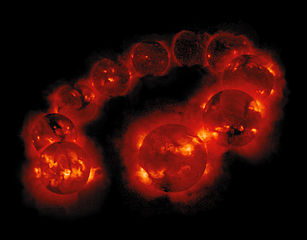
Climate change is real.
However, serious scientific evidence is pointing to a very different causality
than most discuss. Climate is a huge subject, an immensely complex one. There
is controversy around whether we must implement drastic new taxes on fuels or
other measures to reduce or “capture” CO2 to reduce Man-Made Global Warming. So
far however, there are strong indications we are ignoring what might be a far
greater factor in our climate and in increasing occurrence of severe weather
around the world, from hurricanes to volcanic eruptions to earthquakes to
severe cold, severe warm and severe rainfall. One causal factor being ignored
in all the discussion is what influence solar activity has on our climate. We
might well be ignoring this to our peril.
Sunspots and solar minimum
Pretty much everything in
nature moves in some form of cycle, whether it is the Earth around the Sun or
the moon around the Earth. Those cycles have been known for ages to influence
the ocean tides or growing seasons. What is less known is the fact that there
are cycles to solar eruptions, giant electromagnetic storms often called
sunspots. It has been measured over time that solar cycles have short cycles of
approximately 11 years.
According to the US NASA, “The
solar cycle is the cycle that the Sun’s magnetic field goes through
approximately every 11 years…The solar cycle affects activity on the surface of
the Sun, such as sunspots which are caused by the Sun’s magnetic fields.” These
shorter 11 year cycles take place within longer cycles of around 90 to 100
years, 200 years or longer.
Astrophysicists measure such
cycles from the number of sunspots daily by year. It takes eleven years to
proceed from minimum solar eruption year to a peak and down to the next
minimum–think sine waves. That means the number of solar eruptions is at a
minimum before beginning the next cycle of 11 year rise and fall. The relevant
point for us on earth is that those giant solar eruptions, as well as the
relative absence of same, have huge impact on our earth and on climate. The
sunspot activity has been noted and measured for about 350 years.
What is less well understood
but empirically measured are the larger longer wave cycles of sunspot rise and
decline. In 2019 we are at the apparent bottom of what is called Cycle 24. If
the present spotless pattern continues to year-end 2019 it could be perhaps the
deepest Solar Minimum of a century. Notable here is that the peak number of
sunspots has been declining with each cycle since Cycle 22 that began in around
1986. Some scientists predict that Cycle 25 in 2020 will begin a series of even
more unusually low sunspot activity lasting perhaps into 2055 or even longer.
If so, it will have significant influence on our climate and weather.


