Meeting with heads of international news agencies
Vladimir Putin began his work at the St
Petersburg International Economic Forum by meeting with the heads
of international news agencies.
June 1, 2017
13:30
St Petersburg
16:58
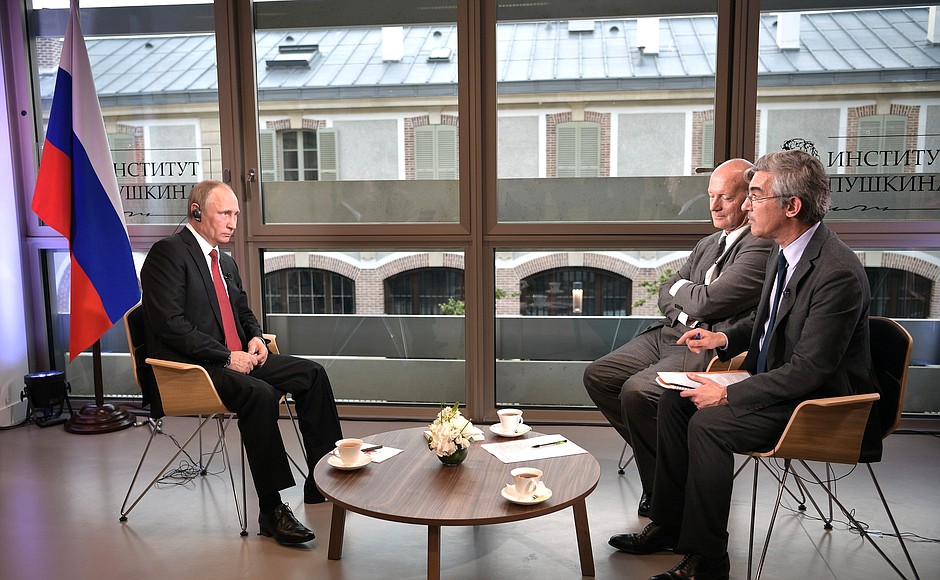
Taking part in the meeting were President
of EFE (Spain) Jose Antonio Vera, Editor-in-Chief of PTI (India)
Vijay Joshi, Vice President of Kyodo News (Japan) Juno Kondo, General
Director of DPA (Germany) Peter Kropsch, Editor-in-Chief of Anadolu
(Turkey) Metin Mutanoglu, First Vice President of Xinhua (China) Zhang
Sutan, Vice President of Associated Press (USA) Ian Phillips, Deputy
Editor-in-Chief of Bloomberg (USA) John Fraher, President
and Director General of ANSA (Italy) Giuseppe Cerbone, CEO
and Editor-in-Chief of TT Group (Sweden) and President
of the European Alliance of News Agencies Jonas Eriksson. Russia
was represented at the meeting by Director General of TASS
Sergei Mikhailov.
* * *
President of Russia Vladimir Putin: Friends,
colleagues,
It is a great pleasure to see you again
in St Petersburg on the sidelines of the St Petersburg
International Economic Forum.
We meet regularly on the forum’s sidelines,
but for some reason, these meetings always took place
in the evening and went on very late into the night.
This time, we have a chance to discuss things with a fresh head,
as it were.
I am very happy to see you. I give
the floor to Mr Mikhailov, who will say a few opening remarks
before we begin our informal discussion. You have the floor.
Director General of TASS Sergei Mikhailov: Thank
you, Mr President.
Colleagues, following tradition, I will attempt
to moderate our meeting today.
This is the fourth time now that we are meeting
on the sidelines of the St Petersburg International
Economic Forum. Many of my colleagues present here today are not
meeting with you for the first time, but our circle
of participants changes each year, and we have new colleagues this
year and it is a pleasure to welcome them to St Petersburg.
I hope that this inflow of new blood will mix organically with the experience
of the old hands and will produce a fruitful
and interesting dialogue for all.
Mr President, it always seems that all that needs
to be said has been said after each of these meetings, but
at the same time, we know that next year will bring new subjects
of discussion. This is the case this year too.
We have discussed things together, and we see
the stubborn efforts underway to push Russia against its will into
conflictual confrontation with the West. The media and some
politicians constantly foment anti-Russian sentiments, and some
politicians even put us in the same ranks as ISIS
and terrorists. Baltic countries have even started suspecting that
the popular children’s cartoon Masha i Medved could be used
as a tool in hybrid war. You met with the cartoon makers
yesterday, this is why I recalled this example.
But excesses of this kind no longer raise
a smile and, it seems to me, are even becoming a threat
to stability in the world. How long do you think these unfounded
attacks on Russia will continue? What should we do to end this
political Russophobia? This is the first question that I wanted
to put today.
Vladimir Putin: First of all, yes, I would
like to share my reflections and thoughts on what is
happening and on the reasons for this Russophobia. It is
evident and in some countries is simply going beyond all bounds.
Why is this so? I think this is because we are
seeing the emergence of a multipolar world, and this is not
to the monopolists’ liking. Monopolies are not good things,
as we know, but monopolists always fight to keep hold of them,
in all sectors and all areas of life.
A multipolar world is emerging and this is
partly due to Russia’s efforts to stand up for its interests,
for its legitimate interests, let me stress. That is one aspect.
The second aspect is that some of our
partners in some countries began making attempts a while back
to contain Russia and limit its lawful desire to protect its
national interests. They do this through all kinds of actions that are
outside the framework of international law, including economic
restrictions. Now, they see that this is not working and has produced no
results. This irritates them and rouses them into using other methods
to pursue their aims and tempts them to up the stakes. But
we do not go along with these attempts, do not offer pretexts for action.
They therefore need to invent pretexts out of nowhere.
How long will this last? I do not think it will
go on forever, because sooner or later, people will wake up
to the fact that this is counterproductive and harmful
to all. Of course, it causes us some harm, but it also harms those
who initiate these policies. I think that people are already coming around
to this realisation. We see some very clear change in the situation,
change for the better. I hope that this trend will continue.
Sergei Mikhailov: Thank you, Mr President.
Last year, as you rightly noted, we finished
after midnight, and the weather prevented some of our colleagues
from putting their questions, and so we decided that it would be only fair
to start with them this time.
The head of one of Germany’s top news
agencies is here for the first time this year. It is pleasure
to introduce General Director of DPA Mr Peter Kropsch. He is
at the forum for the first time, but he came to St
Petersburg before, back in 1981, as part of a youth
delegation organised by what was then the Austro-Soviet friendship
society, and so he sees much change in the city now.
He also expressed his envy over your 8th dan
black belt, because he has a black belt, but only 1st dan,
and he said that it would take him 50 years of training to reach
your level.
Peter, you have the floor.
General Director of DPA Peter Kropsch: (In German.) I want
to thank you for finding the time to meet with
my colleagues and me.
(In English.) I’m going to switch
to English. This is a little better and I have
a question. We will have parliamentary elections in Germany this year
and what do you think in the sense of the relationship
between Germany and Russia? Would you prefer to work with your
partner Chancellor Merkel or could you imagine that with Chancellor Schulz
you could even make bigger progress?
And maybe a second question. I know you
answered that but I am asking for your advice. There is always
a kind of nervosity in Germany about the situation that it
could be that some hackers, maybe also from Russia, could try
to influence, by leaking information or by false
information, this election process. Would you think that could be possible
and what would be your advice for Germany and the German
officials?
Vladimir Putin: The first part of your
question concerns relations with my partners and colleagues
in Germany.
I have known and worked together with Angela
[Merkel] for a long time now. We do have our differences, but we have
many areas of common ground too, especially in economic cooperation.
We share similar views on some issues in international politics too.
As I said though, there are issues on which we differ
in our policy approaches.
I hardly know Mr Schulz at all, but
I know he is an experienced person who has been in politics
for a long time. He has been in European politics
and in German politics, and has recently returned to German
politics. In principle, we – and when I say ‘we’,
I mean the entire Russian team – are ready to work with
anyone. The main thing is to have partners who, like us, seek
constructive cooperation. We have no preferences in this respect.
I think that if we and partners act not out
of political considerations of the moment, but are guided
by our countries’ and peoples’ fundamental interests, not only will
we find common ground, but we will find good and effective roads
for working together, effective means of cooperation.
I have no doubt whatsoever about this because we
have so many interests in common. After all, our cooperation in some
economic sectors and our interdependency in some sectors is such that
dozens if not hundreds of thousands of jobs in both countries
depend on its successful development. This is a powerful factor
for our coexistence in today’s world and all the more so in Europe.
Some German producers make big profits out
of working on the Russian market. There is no need to be
an expert or specialist to understand that the Russian
economy needs to develop technology cooperation. In this area, we
have been working together with success and we have results. I am
thinking of the recovery in our trade with Germany,
for example, which was up by nearly 40 percent in the first
quarter of this year. This, I think, is significant growth.
But I am thinking too of the many
projects that we are carrying out with success, and that increase
the amount of high-tech goods produced on Russian soil.
In other words, this is a serious localisation effort,
and localisation reaches up to 60–70 percent. The automotive
sector provides a good example. Despite the political difficulties,
not a single German company, and the same is true of our
other foreign partners, has left the Russian market. Everyone continues
working. And this is despite the political and also economic
difficulties, the fall in production, drop in GDP, decrease
in people’s real incomes and the corresponding fall
in demand. Everyone is working all the same. The state
authorities are doing their best to support them and we are
continuing this constructive work.
That is not to mention the energy sector.
Germany has decided to phase out nuclear energy, but nuclear energy
accounts for a big share of Germany’s energy, bigger than
in Russia today. Where will Germany get its energy from? We see that
Norway’s resources are coming to an end, and Britain will soon
be a net consumer country. Their resources are also dwindling. So, where
will the energy come from?
At the last forum, we spoke about
the prospects on the Yamal Peninsula, where we had reserves
of 2.7 trillion cubic metres of gas. Gazprom just briefed me
on the new reserves they have discovered there. Can you imagine what
this increase represents? It’s a two-fold increase. We have another 4.2
trillion cubic metres there, and that is just in one small region.
But these reserves are global in scale, and given Russia’s proximity
to Europe and cheap logistics and well-organised procedures
and technology, this is an absolutely natural partnership. We offer
a cheap and clean energy source, if its hydrocarbons we’re looking
at. This is absolutely natural. In the long term, if we look
at long-term contracts, this guarantees stable supplies and – also
very important – guarantees that the entire German economy is
competitive. This is tremendously important. It’s a relatively cheap
resource and comes from a reliable source.
We also have historically strong humanitarian ties
and contacts between people. This has always been the case. Despite
the tragedies of two wars, our peoples have always maintained their
contacts.
I say all this simply in the hope that
Germany will be led by people who understand all of these relations,
and we take the position that no matter who is in power
in Germany, these fundamental factors in our relations will play
a positive role.
Now regarding hackers: hackers can be anywhere, they
can lurk in any country in the world. Of course,
the general context of inter-state relations should be taken into
account in this case because hackers are free people like artists. If artists
get up in the morning feeling good, all they do all day is paint.
The same goes for hackers. They got up today and read that
something is going on internationally. If they are feeling patriotic they
will start contributing, as they believe, to the justified fight
against those speaking ill of Russia. Is that possible? In theory,
yes. At the government level, we never engage in this. This is
what is most important. This is the first point.
Second. I can image a scenario when somebody
develops a chain of attacks in a manner that would show
Russia as the source of these attacks. Modern technology allows
that. It is very easy.
And finally, what is most important is I am
deeply convinced that no hackers can have a real impact
on an election campaign in another country. You see, nothing, no
information can be imprinted in voters’ minds, in the minds
of a nation, and influence the final outcome
and the final result. This is my answer.
We do not engage in this activity
at the government level and are not going to engage
in it. On the contrary, we try to prevent this from
happening in our country. At any rate, I believe that no hackers
can affect the election campaign in any European country, nor
in Asia or in America.
Sergei Mikhailov: Thank you, Mr President.
Our next colleague who did not have the opportunity
to ask a question last year and reminded me about this
for the whole year is Juno Kondo from Kyodo News, Japan’s leading
news agency. TASS opened its office in Tokyo and Kyodo in Moscow
before our countries exchanged embassies.
This year there has been an unprecedented level
of activity in the way our two countries are working
to develop relations and business ties and searching
to find new approaches to old problems. Just by coincidence, like
our previous colleague, Mr Juno Kondo has the third dan in karate
and the first dan in judo. There is a surprising amount
of enthusiasm about martial arts among our colleagues.
Vladimir Putin: We are a tight circle here.
As for those who have not yet mastered the martial arts,
I suggest that we, as experts in these arts, should help our
colleagues study them up.
Sergei Mikhailov: I suggest simply meeting
on the tatami next time, Mr President.
Vladimir Putin: All right.
Vice President of Kyodo News Juno Kondo (retranslated): Thank
you very much for letting me ask a question. It is about
Russian-Japanese relations and southern Kurile Islands. You agreed with Mr
Abe on joint economic activities in southern Kurils. This will
certainly help build trust between Japan and Russia.
But as for the attitude
of the Japanese, we know that Russia is building up military
preparations on the islands of Iturup and Kunashir
and we are naturally worried about this.
On the other hand, Russia may also have
grounds for concern. If Japan receives two islands after
the conclusion of a peace treaty, US troops may be deployed
there in accordance with the Japanese-US security treaty.
In this respect, I want to ask, is
demilitarisation of the southern Kuril Islands possible?
I believe it is not possible to resolve the issue of these
islands now, of course, but if you do have a position on this
matter, I would very much like to hear it. What possible solutions do
you see on this issue?
And a second question concerning North
Korea’s nuclear and missile programmes. This is unquestionably a grave
threat for security throughout Northeast Asia. What prospects
for solutions do you see here, in particular in light
of American military activity in the region?
Vladimir Putin: First, concerning the military
build-up in the Russian Far East and on the islands
in particular, this was not Russia’s initiative. The same applies
to the situation in Europe. NATO bases are coming ever closer
to our western borders, infrastructure creeps closer, and contingents
are being beefed up. What are we to do in this situation? Are we
to watch on idly? No, we cannot and will not. We are taking
the appropriate responses.
The same is happening in the east. One
aircraft carrier sailed to the region, then a second American
aircraft carrier arrived, and there are reports of a third
heading for the region now. This is not the end
of the world – aircraft carriers come and leave again, but
components of a missile defence system are being installed
as well, and this is a great concern, which we have spoken about
for the last decade, because it destroys the strategic balance
in the world.
You are all experienced adults with decades spent
working in the news field, but you keep silent on this issue.
The world remains silent as if nothing were happening. No one is
listening to us, and if they are listening, they do not pass
on our message further. The global public is living in ignorance
of this whole situation, but what is happening is a very serious
and worrying process. Missile defences are being put in place
in Alaska, and now in South Korea. Like with what is happening
to the west of Russia, are we to look on idly
at what is happening to the east? No, of course we cannot.
We are considering possible responses to this challenge, and it is
a challenge in our eyes.
When we raised the issue
of the American BMD system in Europe, they cited
the problem of Iran, saying that they are doing this
to neutralise Iran’s nuclear programme and the threat it
allegedly presented. But since then we have signed an agreement with Iran
that removed this alleged threat, and the international community has
agreed that there are reliable safeguards. The IAEA shares this view.
However, the development of ballistic missile defence sites goes
on at a fast pace. Who is it designed against?
We kept saying that the above arguments hold no
water, and that they are trying to deceive us. They replied that Iran
is their only target. Now I am the only one to keep talking
about this, while the rest stay silent and pretend not to understand
what I mean. But you do know what I mean. Why do you stay silent
then? Meanwhile, the situation is getting worse. This is pushing
the arms race into a new round. This is obvious. And so we are
pondering a response. We are thinking about ways to improve our
missile defence system. This is a new round of the arms race
exactly.
The same applies to the [disputed]
islands. We are concerned with our security. We are thinking about ways
to neutralise possible threats a long distance from the border.
The islands are a convenient place for this. In other
words, I do not agree that we have taken the initiative
to militarise them. No, we have been forced to reply
to the developments in the region.
Of course, you can refer to the North
Korean nuclear missile threat, just as it happened in the case
of Iran. But I do not think that North Korea is really
the point. If Pyongyang announces tomorrow that it is going
to abandon the nuclear tests and its nuclear weapons programme,
the United States will continue to develop its BMD system under some
other pretext or without any pretext at all, as it is doing
in Europe now. We must definitely bear this in mind.
I do not want to build up tensions, but you
have asked a question and I had to explain our position.
Coming to your second part,
to the theoretical possibility that American troops could be
stationed on the islands if they were to become Japanese
sovereign territory, yes, this possibility exists. This stems from the treaty,
from the protocols that were signed. We have not seen them, but we have
an overall idea of their content.
I won’t go into the details now, though
I am familiar with them, but the possibility for stationing
American troops on the islands exists. Of course, we could ask,
does Russia plan to worsen its relations with the United States
in some way, and does this possibility frighten us? No, we have no
such intentions, and nothing frightens us, but we see, for example,
what is happening now in the United States, we see
the anti-Russian campaign and the Russophobia that continue
there. How will this situation develop? We do not know, and it does not
depend on us, as we did not begin this whole process. In this
situation, we can theoretically imagine that today everything is fine,
and tomorrow they deploy missile defence system components there too. This
would be totally unacceptable to us.
Is demilitarisation possible? Yes, of course it
is, but simply demilitarising these islands alone is not enough. We need
to look at how to reduce tension in the region
in general. Only then can we look at serious, long-term agreements.
It is difficult to say right now just what kind of agreements they
might be, but I do think they are possible.
Sergei Mikhailov: Thank you, Mr President.
<…>