
Vladimir Putin’s Address to the United Nations
Security Council. Video and Transcript
Global Research, October 02, 2015
United Nations. Transcript, Russian Presidency
70th session of the UN General
Assembly
Vladimir Putin took part in the plenary
meeting of the 70th session of the UN
General Assembly in New York.
September 28, 2015
19:25 New York
The UN General Assembly is the United
Nations Organisation’s main consultative body and examines
the principles for cooperation in ensuring international peace
and security.
SCROLL DOWN FOR THE COMPLETE TRANSCRIPT OF PRESIDENT
PUTIN’S ADDRESS
President of Russia Vladimir Putin:
Mr. President,
Mr. Secretary General,
Distinguished heads of state and government,
Ladies and gentlemen,
The 70th anniversary of the United
Nations is a good occasion to both take stock of history
and talk about our common future. In 1945, the countries that
defeated Nazism joined their efforts to lay a solid foundation
for the postwar world order. Let me remind you that key decisions
on the principles defining interaction between states, as well
as the decision to establish the UN, were made in our
country, at the Yalta Conference of the leaders
of the anti-Hitler coalition.
The Yalta system was truly born in travail.
It was born at the cost of tens of millions of lives
and two world wars that swept through the planet
in the 20th century. Let’s be fair: it helped humankind pass through
turbulent, and at times dramatic, events of the last seven
decades. It saved the world from large-scale upheavals.
The United Nations is unique in terms
of legitimacy, representation and universality. True, the UN has
been criticized lately for being inefficient
or for the fact that decision-making on fundamental issues
stalls due to insurmountable differences, especially among Security
Council members.
However, I’d like to point out that there have
always been differences in the UN throughout the 70 years
of its history, and that the veto right has been regularly used
by the United States, the United Kingdom, France, China
and the Soviet Union, and later Russia. It is only natural
for such a diverse and representative organization. When
the UN was first established, nobody expected that there would always be
unanimity. The mission of the organization is to seek
and reach compromises, and its strength comes from taking different
views and opinions into consideration. The decisions debated within
the UN are either taken in the form of resolutions
or not. As diplomats say, they either pass or they don’t. Any
action taken by circumventing this procedure is illegitimate
and constitutes a violation of the UN Charter
and contemporary international law.
We all know that after the end
of the Cold War the world was left with one center
of dominance, and those who found themselves at the top
of the pyramid were tempted to think that, since they are so powerful
and exceptional, they know best what needs to be done and thus
they don’t need to reckon with the UN, which, instead
of rubber-stamping the decisions they need, often stands
in their way.
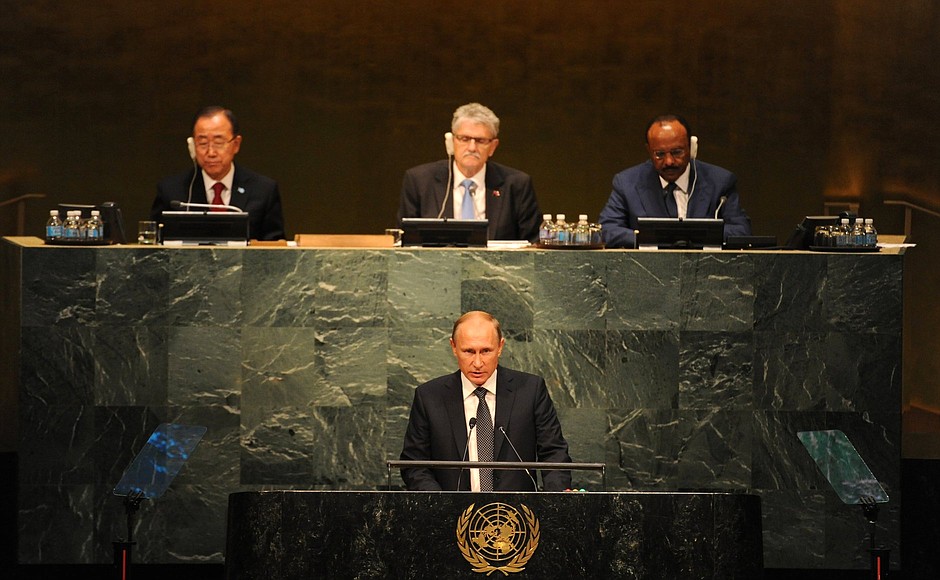
70th session of the UN General Assembly.
That’s why they say that the UN has run its
course and is now obsolete and outdated. Of course,
the world changes, and the UN should also undergo natural
transformation. Russia is ready to work together with its partners
to develop the UN further on the basis of a broad
consensus, but we consider any attempts to undermine the legitimacy
of the United Nations as extremely dangerous. They may result
in the collapse of the entire architecture of international
relations, and then indeed there will be no rules left except
for the rule of force. The world will be dominated
by selfishness rather than collective effort, by dictate rather than
equality and liberty, and instead of truly independent states we
will have protectorates controlled from outside.
What is the meaning of state sovereignty,
the term which has been mentioned by our colleagues here? It
basically means freedom, every person and every state being free
to choose their future.
By the way, this brings us
to the issue of the so-called legitimacy of state
authorities. You shouldn’t play with words and manipulate them.
In international law, international affairs, every term has to be
clearly defined, transparent and interpreted the same way by one
and all.
We are all different, and we should respect that.
Nations shouldn’t be forced to all conform to the same
development model that somebody has declared the only appropriate one.
We should all remember the lessons
of the past. For example, we remember examples from our Soviet
past, when the Soviet Union exported social experiments, pushing
for changes in other countries for ideological reasons,
and this often led to tragic consequences and caused degradation
instead of progress.
It seems, however, that instead of learning from
other people’s mistakes, some prefer to repeat them and continue
to export revolutions, only now these are “democratic” revolutions. Just
look at the situation in the Middle East and Northern
Africa already mentioned by the previous speaker. Of course,
political and social problems have been piling up for a long
time in this region, and people there wanted change. But what was
the actual outcome? Instead of bringing about reforms, aggressive
intervention rashly destroyed government institutions and the local
way of life. Instead of democracy and progress, there is now
violence, poverty, social disasters and total disregard for human
rights, including even the right to life.
I’m urged to ask those who created this
situation: do you at least realize now what you’ve done? But I’m afraid
that this question will remain unanswered, because they have never abandoned
their policy, which is based on arrogance, exceptionalism
and impunity.
Power vacuum in some countries
in the Middle East and Northern Africa obviously resulted
in the emergence of areas of anarchy, which were quickly
filled with extremists and terrorists. The so-called Islamic State
has tens of thousands of militants fighting for it, including
former Iraqi soldiers who were left on the street after the 2003
invasion. Many recruits come from Libya whose statehood was destroyed
as a result of a gross violation of UN Security
Council Resolution 1973. And now radical groups are joined by members
of the so-called “moderate” Syrian opposition backed
by the West. They get weapons and training, and then they
defect and join the so-called Islamic State.
In fact, the Islamic State itself did not
come out of nowhere. It was initially developed as a weapon
against undesirable secular regimes. Having established control over parts
of Syria and Iraq, Islamic State now aggressively expands into other
regions. It seeks dominance in the Muslim world and beyond.
Their plans go further.
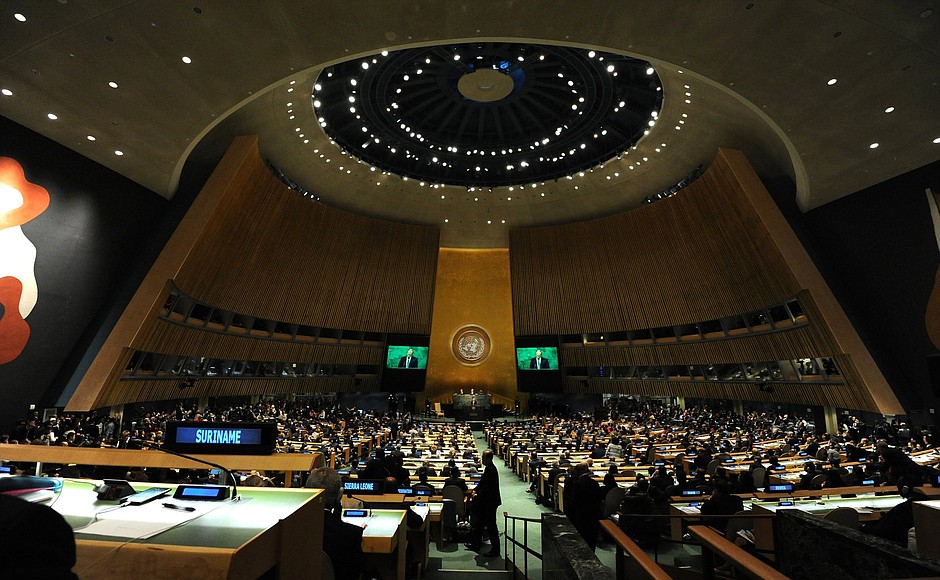
70th session of the UN General Assembly.
The situation is extremely dangerous.
In these circumstances, it is hypocritical and irresponsible
to make declarations about the threat of terrorism
and at the same time turn a blind eye
to the channels used to finance and support terrorists,
including revenues from drug trafficking, the illegal oil trade
and the arms trade.
It is equally irresponsible to manipulate
extremist groups and use them to achieve your political goals, hoping
that later you’ll find a way to get rid of them or somehow
eliminate them.
I’d like to tell those who engage in this:
Gentlemen, the people you are dealing with are cruel but they are not
dumb. They are as smart as you are. So, it’s a big question:
who’s playing who here? The recent incident where the most “moderate”
opposition group handed over their weapons to terrorists is a vivid
example of that.
We consider that any attempts to flirt with
terrorists, let alone arm them, are short-sighted and extremely dangerous.
This may make the global terrorist threat much worse, spreading it
to new regions around the globe, especially since there are fighters
from many different countries, including European ones, gaining combat
experience with Islamic State. Unfortunately, Russia is no exception.
Now that those thugs have tasted blood, we can’t allow
them to return home and continue with their criminal activities.
Nobody wants that, right?
Russia has consistently opposed terrorism in all
its forms. Today, we provide military-technical assistance to Iraq, Syria
and other regional countries fighting terrorist groups. We think it’s
a big mistake to refuse to cooperate with the Syrian
authorities and government forces who valiantly fight terrorists
on the ground.
We should finally admit that President Assad’s
government forces and the Kurdish militia are the only forces
really fighting terrorists in Syria. Yes, we are aware of all
the problems and conflicts in the region, but we definitely
have to consider the actual situation on the ground.
Dear colleagues, I must note that such
an honest and frank approach on Russia’s part has been recently
used as a pretext for accusing it of its growing
ambitions — as if those who say that have no ambitions at all.
However, it is not about Russia’s ambitions, dear colleagues, but about
the recognition of the fact that we can no longer tolerate
the current state of affairs in the world.
What we actually propose is to be guided
by common values and common interests rather than by ambitions.
Relying on international law, we must join efforts to address
the problems that all of us are facing, and create
a genuinely broad international coalition against terrorism. Similar
to the anti-Hitler coalition, it could unite a broad range
of parties willing to stand firm against those who, just like
the Nazis, sow evil and hatred of humankind.
And of course, Muslim nations should play a key role
in such a coalition, since Islamic State not only poses a direct
threat to them, but also tarnishes one of the greatest world
religions with its atrocities. The ideologues of these extremists
make a mockery of Islam and subvert its true humanist values.
I would also like to address Muslim
spiritual leaders: Your authority and your guidance are of great
importance right now. It is essential to prevent people targeted
for recruitment by extremists from making hasty decisions,
and those who have already been deceived and, due to various circumstances,
found themselves among terrorists, must be assisted in finding a way
back to normal life, laying down arms and putting an end
to fratricide.
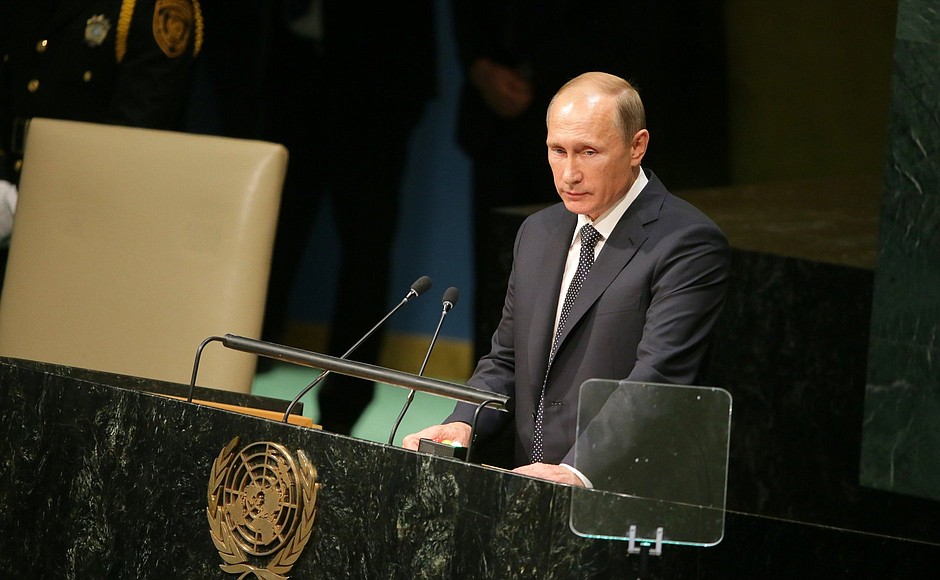
70th session of the UN General Assembly.
In the days to come, Russia,
as the current President of the UN Security Council, will
convene a ministerial meeting to carry out a comprehensive
analysis of the threats in the Middle East. First
of all, we propose exploring opportunities for adopting
a resolution that would serve to coordinate the efforts
of all parties that oppose Islamic State and other terrorist groups.
Once again, such coordination should be based upon the principles
of the UN Charter.
We hope that the international community will be
able to develop a comprehensive strategy of political
stabilization, as well as social and economic recovery
in the Middle East. Then, dear friends, there would be no need
for setting up more refugee camps. Today, the flow of people
forced to leave their native land has literally engulfed, first,
the neighbouring countries, and then Europe. There are hundreds
of thousands of them now, and before long, there might be
millions. It is, essentially, a new, tragic Migration Period,
and a harsh lesson for all of us, including Europe.
I would like to stress that refugees
undoubtedly need our compassion and support. However, the only way
to solve this problem for good is to restore statehood where it
has been destroyed, to strengthen government institutions where they still
exist, or are being re-established, to provide comprehensive
military, economic and material assistance to countries
in a difficult situation, and certainly to people who,
despite all their ordeals, did not abandon their homes. Of course, any
assistance to sovereign nations can, and should, be offered rather
than imposed, in strict compliance with the UN Charter. In other
words, our Organisation should support any measures that have been,
or will be, taken in this regard in accordance with
international law, and reject any actions that are in breach
of the UN Charter. Above all, I believe it is of utmost
importance to help restore government institutions in Libya, support
the new government of Iraq, and provide comprehensive assistance
to the legitimate government of Syria.
Dear colleagues, ensuring peace and global
and regional stability remains a key task
for the international community guided by the United
Nations. We believe this means creating an equal and indivisible
security environment that would not serve a privileged few, but everyone.
Indeed, it is a challenging, complicated and time-consuming task, but
there is simply no alternative.
Sadly, some of our counterparts are still
dominated by their Cold War-era bloc mentality and the ambition
to conquer new geopolitical areas. First, they continued their policy
of expanding NATO – one should wonder why, considering that
the Warsaw Pact had ceased to exist and the Soviet Union
had disintegrated.
Nevertheless, NATO has kept on expanding,
together with its military infrastructure. Next, the post-Soviet states
were forced to face a false choice between joining the West
and carrying on with the East. Sooner or later, this logic
of confrontation was bound to spark off a major geopolitical
crisis. And that is exactly what happened in Ukraine, where
the people’s widespread frustration with the government was used
for instigating a coup d’état from abroad. This has triggered
a civil war. We are convinced that the only way out of this dead
end lies through comprehensive and diligent implementation
of the Minsk agreements of February 12th, 2015. Ukraine’s
territorial integrity cannot be secured through the use of threats
or military force, but it must be secured. The people of Donbas
should have their rights and interests genuinely considered,
and their choice respected; they should be engaged in devising
the key elements of the country’s political system, in line
with the provisions of the Minsk agreements. Such steps would
guarantee that Ukraine will develop as a civilized state,
and a vital link in creating a common space
of security and economic cooperation, both in Europe and in Eurasia.
Ladies and gentlemen, I have deliberately mentioned
a common space for economic cooperation. Until quite recently, it
seemed that we would learn to do without dividing lines
in the area of the economy with its objective market laws,
and act based on transparent and jointly formulated rules,
including the WTO principles, which embrace free trade and investment
and fair competition. However, unilaterally imposed sanctions
circumventing the UN Charter have all but become commonplace today. They
not only serve political objectives, but are also used for eliminating
market competition.
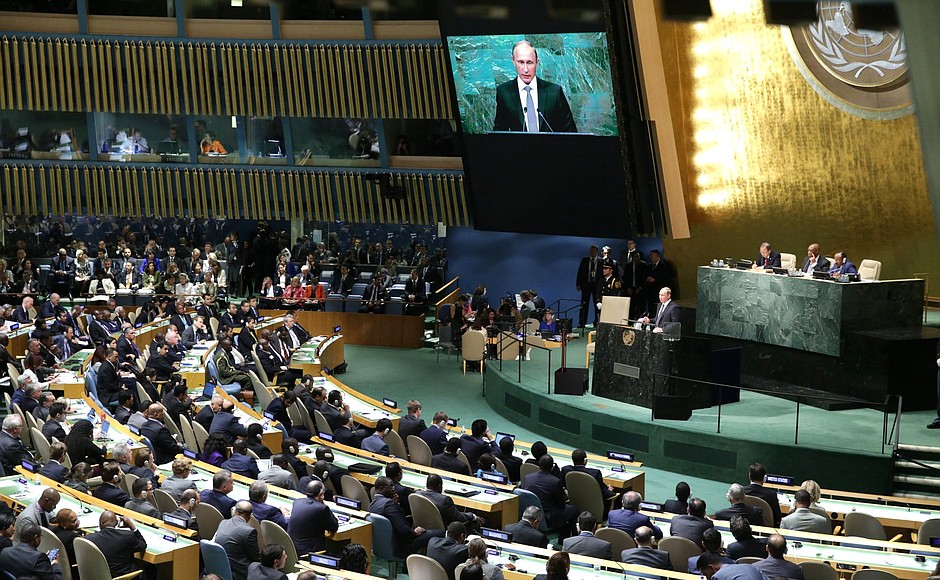
70th session of the UN General Assembly
I would like to note one more sign
of rising economic selfishness. A number of nations have chosen
to create exclusive economic associations, with their establishment being
negotiated behind closed doors, secretly from those very nations’ own public
and business communities, as well as from the rest
of the world. Other states, whose interests may be affected, have not
been informed of anything, either. It seems that someone would like
to impose upon us some new game rules, deliberately tailored
to accommodate the interests of a privileged few, with
the WTO having no say in it. This is fraught with utterly unbalancing
global trade and splitting up the global economic space.
These issues affect the interests of all
nations and influence the future of the entire global
economy. That is why we propose discussing those issues within
the framework of the United Nations, the WTO
and the G20. Contrary to the policy of exclusion,
Russia advocates harmonizing regional economic projects. I am referring
to the so-called ”integration of integrations“ based
on the universal and transparent rules of international
trade. As an example, I would like to cite our plans
to interconnect the Eurasian Economic Union with China’s initiative
for creating a Silk Road economic belt. We continue to see great
promise in harmonizing the integration vehicles between
the Eurasian Economic Union and the European Union.
Ladies and gentlemen, one more issue that shall
affect the future of the entire humankind is climate change. It
is in our interest to ensure that the coming UN Climate Change
Conference that will take place in Paris in December this year should
deliver some feasible results. As part of our national contribution,
we plan to limit greenhouse gas emissions to 70–75 percent
of the 1990 levels by the year 2030.
However, I suggest that we take a broader
look at the issue. Admittedly, we may be able to defuse it
for a while by introducing emission quotas and using other
tactical measures, but we certainly will not solve it for good that way.
What we need is an essentially different approach, one that would involve
introducing new, groundbreaking, nature-like technologies that would not damage
the environment, but rather work in harmony with it, enabling us
to restore the balance between the biosphere and technology
upset by human activities.
It is indeed a challenge of global
proportions. And I am confident that humanity does have
the necessary intellectual capacity to respond to it. We need
to join our efforts, primarily engaging countries that possess strong
research and development capabilities, and have made significant
advances in fundamental research. We propose convening a special
forum under the auspices of the UN to comprehensively
address issues related to the depletion of natural resources,
habitat destruction, and climate change. Russia is willing
to co-sponsor such a forum.
Ladies and gentlemen, dear colleagues.
On January 10th, 1946, the UN General Assembly convened for its
first meeting in London. Chairman of the Preparatory Commission
Dr. Zuleta Angel, a Colombian diplomat, opened the session
by offering what I see as a very concise definition
of the principles that the United Nations should be based upon,
which are good will, disdain for scheming and trickery,
and a spirit of cooperation. Today, his words sound like
guidance for all of us.
Russia is confident of the United Nations’
enormous potential, which should help us avoid a new confrontation
and embrace a strategy of cooperation. Hand in hand with
other nations, we will consistently work to strengthen the UN’s
central, coordinating role. I am convinced that by working together,
we will make the world stable and safe, and provide
an enabling environment for the development of all nations
and peoples.
Thank you.
Copyright © President Vladimir Putin, United Nations. Transcript, Russian Presidency,
2015


