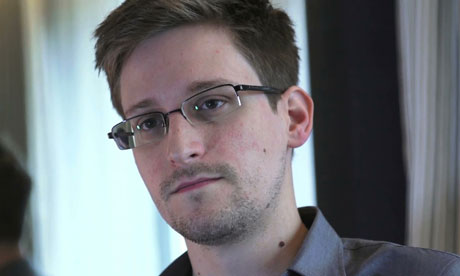
Photograph: Alan Rusbridger for the
Guardian
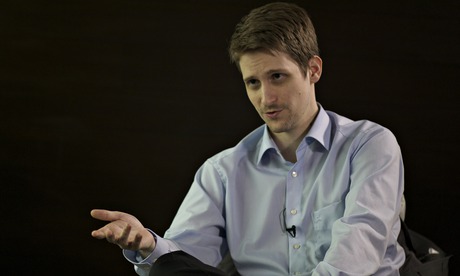
During the seven hours of
interview, Snowden:
• Said if he ended up in US
detention in Guantánamo Bay he could live with it.
• Offered rare glimpses into his
daily life in Russia, insisting that, contrary to reports that he is depressed,
he is not sad and does not have any regrets. He rejected various conspiracy
theories surrounding him, describing as "bullshit" suggestions he is
a Russian spy.
• Said that, contrary to a claim
he works for a Russian organisation, he was independently secure, living on
savings, and money from awards and speeches he has delivered online round the
world.
• Made a startling claim that a
culture exists within the NSA in which, during surveillance, nude
photographs picked up of people in "sexually compromising" situations
are routinely passed around.
• Spoke at length about his
future, which seems destined to be spent in Russia for the foreseeable future
after expressing disappointment over the failure of western European
governments to offer him a home.
• Said he was holding out for a
jury trial in the US rather a judge-only one, hopeful that it would be hard to
find 12 jurors who would convict him if he was charged with an offence to which
there was a public interest defence. Negotiations with the US government on a
return to his country appear to be stalled.
Snowden, who recognises he is
almost certainly kept under surveillance by the Russians and the US, met the
Guardian at a hotel within walking distance of Red Square.
The 31-year-old revealed that he
works online late into the night; a solitary, digital existence not that dissimilar
to his earlier life.
He said he was using part of that
time to work on the new focus for his technical skills, designing encryption tools to help professionals such as journalists
protect sources and data. He is negotiating foundation funding for the project,
a contribution to addressing the problem of professions wanting to protect
client or patient data, and in this case journalistic sources.
"An unfortunate side effect
of the development of all these new surveillance technologies is that the work
of journalism has become immeasurably harder than it ever has been in the
past," Snowden said.
"Journalists have to be
particularly conscious about any sort of network signalling, any sort of
connection, any sort of licence-plate reading device that they pass on their
way to a meeting point, any place they use their credit card, any place they
take their phone, any email contact they have with the source because that
very first contact, before encrypted communications are established, is enough
to give it all away."
Journalists had to ensure they
made not a single mistake or they would be placing sources at risk. The same
duty applied to other professions, he said, calling for training and new
standards "to make sure that we have mechanisms to ensure that the average
member of our society can have a reasonable measure of faith in the skills of
all the members of these professions."
He added: "If we confess
something to our priest inside a church that would be private, but is it any
different if we send our pastor a private email confessing a crisis that we
have in our life?"
The response of professional
bodies in the UK to the challenge varies, ranging from calls for legislative
changes to build in protection from snooping, to apparent lack of concern.
Ross Anderson, professor of
security engineering at Cambridge University, said he shared Snowden's concerns
about the vulnerability of the professions to surveillance by spy and law
enforcement agencies.
"If you think your HIV
status is secret from GCHQ, forget it," he said. "The tools are
available to protect data and communications but only if you are important
enough for your doctor or lawyer to care."
Timothy Hill, technology policy
adviser at the Law Society, which represents UK lawyers, said the profession
was concerned.
"Legal professional
privilege – the right to consult a legal adviser in confidence – is a long
established common law right. Its fundamental role in our legal system needs to
be reasserted."
The society is pressing to have
existing legislation rewritten to include explicit protection for legal
professional privilege from government surveillance.
"There needs to be a debate
about the implications of the Snowden revelations for professional privilege in
the digital age," Hill said. "It is not happening. This is not being
debated in parliament."
He said the society was seeking
to strengthen law firms' cybersecurity awareness but that a stronger statutory
framework was essential.
Michelle Stanistreet, the
National Union of Journalists general secretary, echoed the concerns. "For
democracy to function, it needs to have a free press and journalists who are
able to do their job without fear or hindrance. But this is becoming
increasingly under threat."
She added: "Last year's
revelations show that unencrypted communications can mean that journalists may
be unwittingly handing over their contacts, footage or material, against their
will."
The General Medical Council
provides guidance to UK doctors about protecting information against improper
disclosure.
Niall Dickson, the GMC chief
executive, said: "Modern communication offers huge benefits for patients
in terms of research, access to professionals, as well as speed of care and
treatment. But of course it also carries risk, and confidentiality and trust
are at the heart of the doctor-patient relationship.
"We recognise that keeping
up with advances in technology and its implications for confidentiality are
challenging for all healthcare professionals. We do have guidance which
explains what doctors need to do if they are concerned about the security of
personal information or systems they have been given to use. But in this
rapidly changing area, we also need to keep on top of this ourselves, and we do
regularly review our guidance to take account of changes in the external
environment."