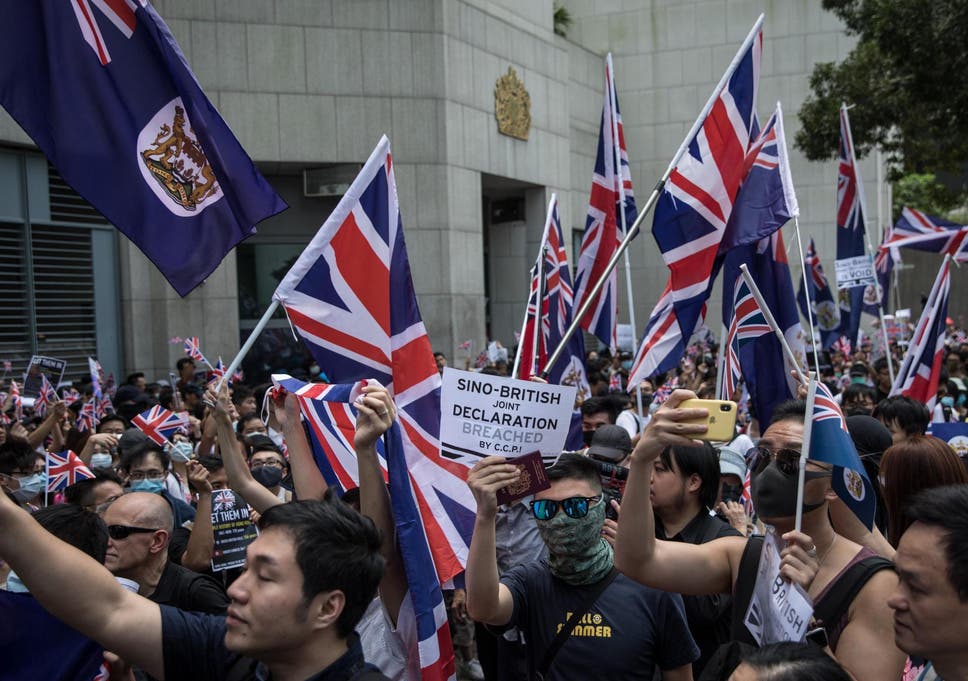
Det er klart at noen av ungdommene i Hong Kong har lagt seg til britisk kultur - etter overleveringen til Kina som deres spesielle provins. De kjenner ikke historien til sitt eget land, og hva de skylder Folkerepublikken Kina. For deres besteforeldre bragte London bare elendighet og ødeleggelse- noe som førte til kollapsen for Midtens Rike.
Hundrevis av unge kinesere står foran det britiske konsulatet i Hong Kong og synger ‘God save the Queen’ og roper «Må Gud bevare Hong Kong’.
En oppfordring til en samling i London av 130 parlamentarikere ba om at innbyggerne i den tidligere kolonien bør få britisk statsborgerskap.
På denne måten vil Storbritannia vise verdensopinionen, spesielt ungdommene, at de vil garantere for deres krav og menneskerettigheter.
Men historien er blitt slettet ut.
Det er derfor nødvendig, før noe annet, å kjenne til de historiske episodene som i første halvdel av det 19. århundret førte til at det kinesiske territoriet Hong Kong ble lagt under britisk herredømme.
Clearly, some young people in Hong Kong have adopted British culture - after the handover to China of their special province. They do not know the history of their country and what they owe to the Peoples’ Republic of China. For their great grandparents, London had brought only misery and desolation, causing the collapse of the Middle Kingdom.
The "Opium Wars" represent the paradigm of British colonialism:London did not seek to dominate the Chinese population politically, but exclusively to exploit it economically.
To impose drug use, Her Most Gracious Majesty, Queen Victoria, waged two wars that caused several million deaths.
Hundreds of young Chinese, in front of the British Consulate in Hong Kong, sing the God Save the Queen and shout "Great Britain Saves Hong Kong", a rally call in London by 130 parliamentarians who ask that British citizenship be given to residents of the former colony. In this way, Britain is emerging in world public opinion, particularly among young people, as a guarantor of legality and human rights. To do this, History is erased.
It is therefore necessary, before any other consideration, to know the historical episodes which, in the first half of the 19th century, brought the Chinese territory of Hong Kong under British rule.
因此,在任何其它考虑之前,有必要了解在十九世纪上半叶,香港领土被英国统治的历史事件。
To penetrate China, then ruled by the Qing dynasty, Britain resorted to the distribution of opium, which it shipped by sea from India where it held the monopoly. The drug market spread rapidly in the country, causing serious economic, physical, moral and social damage that provoked the reaction of the Chinese authorities. But when they confiscated stored opium in Canton and burned it, the British troops occupied this city and other coastal cities with the first Opium War, forcing China to sign the Treaty of Nanjing in 1842.
In Article 3 it states: "As it is obviously necessary and desirable for British subjects to have ports for their ships and their stores, China will forever cede the island of Hong Kong to Her Majesty the Queen of Great Britain. and her heirs ". In Article 6 the Treaty stipulates: "Since Her Britannic Majesty’s Government was obliged to send an expeditionary force to obtain compensation for the damage caused by the Chinese authorities’ violent and unjust procedure, China agrees to pay to Her British Majesty the sum of $ 12 million for expenses incurred.
The Nanking Treaty is the first of the unequal treaties by which the European powers (Great Britain, Germany, France, Belgium, Austria and Italy), Tsarist Russia, Japan and the United States secured in China, by the force of arms, a series of privileges: the cession of Hong Kong to Great Britain in 1843, the sharp reduction of taxes on foreign goods (at a time when European governments were erecting customs barriers to protect their industries), the opening of the main ports to foreign vessels and the right to have urban areas under their own administration ("concessions") exempted from Chinese authority.
In 1898 Great Britain annexed the Kowloon Peninsula in Hong Kong and the so-called News Territories, conceded by China to be "rented" for 99 years.
1898,英国吞并了香港的九龙半岛和所谓的新界,中国承认“出租”了99年。
The widespread dissatisfaction with these impositions exploded towards the end of the 19th century in a popular revolt - that of the Boxers - against which intervened an international expeditionary force of 16,000 men under British command, in which Italy also participated (and France, NdT).
Landed in Tianjin (T’ien Tsin) in August 1900, the force sacked Beijing and other cities, destroying many villages and massacring the population. Later, Britain took control of Tibet in 1903, while Czarist Russia and Japan shared Manchuria in 1907.
In China, reduced to a colonial or semi-colonial state, Hong Kong became the main door of exchange based on the plunder of resources and slave labour exploitation of the population. A huge mass of Chinese are forced to emigrate mainly to the United States, Australia and South-East Asia, where they are subjected to similar conditions of exploitation and discrimination.
Honderden jonge Chinezen zingen voor het Britse consulaat in Hongkong God Save the Queen en roepen "Great Britain Saves Hong Kong", een oproep in Londen van 130 parlementariërs die vragen om het Britse staatsburgerschap te geven aan de inwoners van de voormalige kolonie. Op deze manier komt Groot-Brittannië naar voren in de publieke opinie in de wereld, met name onder jongeren, als een garantie voor de legaliteit en mensenrechten. Door dit te doen, wordt de geschiedenis gewist.
Daarom is het noodzakelijk om eerst de historische gebeurtenissen te kennen die in de eerste helft van de negentiende eeuw het Chinese grondgebied van Hongkong onder Brits gezag hebben gebracht.
Om door te dringen in China, toen onder het bewind van de Qing-dynastie, nam Groot-Brittannië zijn toevlucht tot de distributie van opium, dat het over zee verscheepte vanuit India, waar men het monopolie had. De drugsmarkt verspreidde zich snel in het land en veroorzaakte ernstige economische, fysieke, morele en sociale schade die de reactie van de Chinese autoriteiten uitlokte. Maar toen ze opgeslagen opium in beslag namen en verbrandden, bezetten de Britse troepen deze stad en andere kuststeden met de eerste Opiumoorlog en dwongen ze China om in 1842 het Verdrag van Nanjing te ondertekenen.
In artikel 3 staat: "Aangezien het voor Britse onderdanen uiteraard noodzakelijk en wenselijk is om havens te hebben voor hun schepen en hun voorraden, zal China het eiland Hongkong voor altijd overdragen aan Hare Majesteit de Koningin van Groot-Brittannië. en haar erfgenamen". In artikel 6 van het Verdrag is bepaald dat het eiland voor altijd zal worden overgedragen aan Hare Majesteit de Koningin van Groot-Brittannië. en haar erfgenamen": "Aangezien de regering van Hare Majesteit verplicht was een expeditieleger te sturen om vergoeding te verkrijgen voor de schade die door de gewelddadige en onrechtvaardige procedure van de Chinese autoriteiten is veroorzaakt, stemde China ermee in Hare Majesteit de Britse Majesteit een bedrag van 12 miljoen dollar te betalen voor de kosten die zij heeft gemaakt.
Het Nanking-verdrag is het eerste van de ongelijkmatige verdragen waarmee de Europese mogendheden (Groot-Brittannië, Duitsland, Frankrijk, België, België, Oostenrijk en Italië), het tsaristische Rusland, Japan en de Verenigde Staten in China, door middel van de wapenen, een reeks voorrechten hebben verworven: de overdracht van Hongkong aan Groot-Brittannië in 1843, de sterke verlaging van de belastingen op buitenlandse goederen (in een tijd waarin de Europese regeringen douanebarrières opwierpen om hun industrie te beschermen), de openstelling van de belangrijkste havens voor buitenlandse schepen en het recht om stedelijke gebieden onder hun eigen bestuur te plaatsen ("concessies") die van het Chinese gezag zijn vrijgesteld.
In 1898 heeft Groot-Brittannië het Kowloon Peninsula in Hongkong en de zogenaamde News Territories geannexeerd, die door China werden "gehuurd" voor 99 jaar.
De wijdverbreide ontevredenheid over deze opleggingen explodeerde tegen het einde van de 19e eeuw in een volksopstand - die van de Boxers - waartegen een internationale expeditieleger van 16.000 man onder Brits bevel, waaraan ook Italië (en Frankrijk, NdT) deelnamen, tussenbeide kwam.
Geland in Tianjin (T'ien Tsin) in augustus 1900, plunderde de strijdmacht Beijing en andere steden, het vernietigden vele dorpen en slachte de bevolking af. Later, nam Groot-Brittannië de controle over Tibet in 1903, terwijl tsaristische Rusland en Japan Mantsjoerije deelden in 1907.
In China, gereduceerd tot een koloniale of semi-koloniale staat, werd Hongkong de belangrijkste deur van uitwisseling op basis van de plundering van hulpbronnen en de uitbuiting van de bevolking door slavenarbeiders. Een grote massa Chinezen werd gedwongen te emigreren, vooral naar de Verenigde Staten, Australië en Zuidoost-Azië, waar ze werden onderworpen aan vergelijkbare omstandigheden van uitbuiting en discriminatie.
Een vraag rijst spontaan: Welke geschiedenisboeken zijn jongeren aan het bestuderen die Groot-Brittannië vragen om "Hongkong te redden"?
Hunderte junge Chinesen singen vor dem britischen Konsulat in Hongkong God Save the Queen und rufen "Great Britain Save Hong Kong", eine Kundgebung in London von 130 Parlamentariern, die fordern, dass die britische Staatsbürgerschaft an die Bewohner der ehemaligen Kolonie vergeben wird. Auf diese Weise tritt Großbritannien in der Weltöffentlichkeit, insbesondere bei jungen Menschen, als Garant für Rechtmäßigkeit und Menschenrechte auf. Hierfür wird die Geschichte gelöscht.
Daher ist es notwendig, vor jeder anderen Betrachtung, die historischen Ereignisse zu kennen, die in der ersten Hälfte des 19. Jahrhunderts das chinesische Territorium Hongkongs unter britische Herrschaft gebracht haben.
Um in China einzudringen, das damals von der Qing-Dynastie regiert wurde, bediente sich Großbritannien der Verteilung von Opium, das es auf dem Seeweg aus Indien verschiffte, wo es das Monopol innehatte. Der Drogenmarkt verbreitete sich schnell im Land und verursachte schwere wirtschaftliche, physische, moralische und soziale Schäden, die die Reaktion der chinesischen Behörden auslösten. Aber als die gelagertes Opium in Kanton beschlagnahmten und verbrannten, nahmen die britischen Truppen die Stadt und andere Küstenstädte mit dem ersten Opiumkrieg ein und zwangen China 1842 den Vertrag von Nanjing zu unterzeichnen.
In Artikel 3 heißt es dazu: "Da es für britische Untertanen offensichtlich notwendig und wünschenswert ist, Häfen für ihre Schiffe und ihre Läger zu haben, wird China die Insel Hongkong für immer an Ihre Majestät, die Königin von Großbritannien, und ihre Erben abtreten". In Artikel 6 des Vertrages ist festgelegt: "Da die Regierung Ihrer Britischen Majestät gezwungen war, eine Expeditionstruppe zu entsenden, um eine Entschädigung für den durch das gewalttätige und ungerechte Verfahren der chinesischen Behörden verursachten Schaden zu erhalten, erklärt sich China bereit, Ihrer Britischen Majestät den Betrag von 12 Millionen Dollar für die entstandenen Ausgaben zu zahlen.
Der Nanking-Vertrag ist der erste der ungleichen Verträge, mit denen die europäischen Mächte (Großbritannien, Deutschland, Frankreich, Belgien, Österreich und Italien), das zaristische Russland, Japan und die Vereinigten Staaten in China mit Waffengewalt eine Reihe von Privilegien sicherten: die Abtretung Hongkongs an Großbritannien im Jahr 1843, die drastische Senkung der Steuern auf ausländische Waren (zu einer Zeit, als europäische Regierungen Zollschranken zum Schutz ihrer Industrien errichteten), die Öffnung der wichtigsten Häfen für ausländische Schiffe und das Recht, städtische Gebiete unter eigener Verwaltung ("Konzessionen") von der chinesischen Regierung freizustellen.
1898 annektierte Großbritannien die Halbinsel Kowloon in Hongkong und die so genannten News Territories, die von China für 99 Jahre "gemietet" wurden.
Die weit verbreitete Unzufriedenheit mit diesen Auflagen explodierte gegen Ende des 19. Jahrhunderts in einer Volksrevolte - die der Boxer -, gegen die eine internationale Expeditionstruppe von 16.000 Mann unter britischem Kommando intervenierte, an der auch Italien (und Frankreich, NdT) teilnahmen.
Im August 1900 in Tianjin (T'ienTsin) gelandet, plünderte die Truppe Peking und andere Städte, zerstörte viele Dörfer und massakrierte die Bevölkerung. Später übernahm Großbritannien 1903 die Kontrolle über Tibet, während sich das zaristische Russland und Japan 1907 die Mandschurei teilten.
In China, das zu einem kolonialen oder halbkolonialen Staat reduziert wurde, wurde Hongkong zum Hauptor des Austauschs, der auf der Plünderung von Ressourcen und der Ausbeutung der Bevölkerung durch Sklavenarbeit basierte. Eine riesige Masse von Chinesen war gezwungen auszuwandern, hauptsächlich in die Vereinigten Staaten, nach Australien und Südostasien, wo sie ähnlichen Bedingungen der Ausbeutung und Diskriminierung ausgesetzt sind.
Eine Frage stellt sich spontan: Welche Geschichtsbücher studieren junge Menschen, die Großbritannien bitten, "Hongkong zu retten"?
Clearly, some young people in Hong Kong have adopted British culture - after the handover to China of their special province. They do not know the history of their country and what they owe to the Peoples’ Republic of China. For their great grandparents, London had brought only misery and desolation, causing the collapse of the Middle Kingdom.
VOLTAIRE NETWORK | ROME (ITALY) | 24 SEPTEMBER 2019
The "Opium Wars" represent the paradigm of British colonialism: London did not seek to dominatethe Chinese population politically,but exclusively to exploit it economically.To impose drug use, Her Most Gracious Majesty, Queen Victoria waged two wars that caused several million deaths.
Hundreds of young Chinese, in front of the British Consulate in Hong Kong, sing the God Save the Queen and shout "Great Britain Saves Hong Kong", a rally call in London by 130 parliamentarians who ask that British citizenship be given to residents of the former colony. In this way, Britain is emerging in world public opinion, particularly among young people, as a guarantor of legality and human rights. To do this, History is erased.
It is therefore necessary, before any other consideration, to know the historical episodes which, in the first half of the 19th century, brought the Chinese territory of Hong Kong under British rule.
To penetrate China, then ruled by the Qing dynasty, Britain resorted to the distribution of opium, which it shipped by sea from India where it held the monopoly. The drug market spread rapidly in the country, causing serious economic, physical, moral and social damage that provoked the reaction of the Chinese authorities. But when they confiscated stored opium in Canton and burned it, the British troops occupied this city and other coastal cities with the first Opium War, forcing China to sign the Treaty of Nanjing in 1842.
In Article 3 it states: "As it is obviously necessary and desirable for British subjects to have ports for their ships and their stores, China will forever cede the island of Hong Kong to Her Majesty the Queen of Great Britain. and her heirs ". In Article 6 the Treaty stipulates: "Since Her Britannic Majesty’s Government was obliged to send an expeditionary force to obtain compensation for the damage caused by the Chinese authorities’ violent and unjust procedure, China agrees to pay to Her British Majesty the sum of $ 12 million for expenses incurred.
The Nanking Treaty is the first of the unequal treaties by which the European powers (Great Britain, Germany, France, Belgium, Austria and Italy), Tsarist Russia, Japan and the United States secured in China, by the force of arms, a series of privileges: the cession of Hong Kong to Great Britain in 1843, the sharp reduction of taxes on foreign goods (at a time when European governments were erecting customs barriers to protect their industries), the opening of the main ports to foreign vessels and the right to have urban areas under their own administration ("concessions") exempted from Chinese authority.
In 1898 Great Britain annexed the Kowloon Peninsula in Hong Kong and the so-called News Territories, conceded by China to be "rented" for 99 years.
The widespread dissatisfaction with these impositions exploded towards the end of the 19th century in a popular revolt - that of the Boxers - against which intervened an international expeditionary force of 16,000 men under British command, in which Italy also participated (and France, NdT).
Landed in Tianjin (T’ien Tsin) in August 1900, the force sacked Beijing and other cities, destroying many villages and massacring the population. Later, Britain took control of Tibet in 1903, while Czarist Russia and Japan shared Manchuria in 1907.
In China, reduced to a colonial or semi-colonial state, Hong Kong became the main door of exchange based on the plunder of resources and slave labour exploitation of the population. A huge mass of Chinese are forced to emigrate mainly to the United States, Australia and South-East Asia, where they are subjected to similar conditions of exploitation and discrimination.
A question arises spontaneously: Which history books are young people who ask Britain to "save Hong Kong" studying?
Bazı Hong Kong’lu gençlerin, özel eyaletlerinin Çin’e devredilmesinden sonra İngiliz kültürünü benimsedikleri inkar edilemez. Ülkelerinin tarihini ve Çin Halk Cumhuriyeti’ne neler borçlu olduklarını bilmemektedirler. Dedelerinin dedesi için Londra, Orta Krallık’ın çöküşüne neden olacak şekilde sadece sefalet ve acı getirmişti.
Afyon savaşları İngiliz sömürgeciliğinin paradigmasını sergilemektedir: Londra, Çin halkına siyaseten egemen olma arayışında olmamış, onu sadece ekonomik olarak sömürmeyi hedeflemiştir. Afyon tüketimini dayatmak üzere, Yüce Majesteleri Kraliçe Viktorya milyonlarca kişinin ölümüne yol açan iki savaş yürütmüştür.
Hong Kong’daki İngiliz Konsolosluğu’nun önünde toplanan yüzlerce genç Çinli, God Save the Queen’i söylüyor ve eski sömürgelerinde yaşayanlara İngiliz vatandaşlığının verilmesini talep eden 130 milletvekili tarafından Londra’da dile getirilen bir çağrı olan « Büyük Britanya Hong Kong’u kurtarsın » diye bağırıyor. Bu şekilde İngiltere dünya kamuoyuna, özellikle de gençlere, hukuka uygunluğun ve insan haklarının teminatı olarak sunulmaktadır. Bunun için, Tarih yok sayılmaktadır.
At midday on Friday 5 February, 2016 Julian Assange, John Jones QC, Melinda Taylor, Jennifer Robinson and Baltasar Garzon will be speaking at a press conference at the Frontline Club on the decision made by the UN Working Group on Arbitrary Detention on the Assange case.