
Dear Reader,
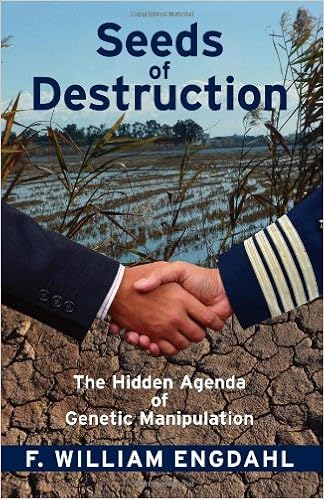
I want to share a section from my bestselling book, Seeds of Destruction: The Hidden Agenda of Genetic Manipulation. It deals with the origins of one of the least-discussed projects, one that has had the greatest consequences for human health and well-being. It is a project financed and sponsored beginning in the 1950’s by a tax exempt US foundation built on a fortune in oil. It gave rise to the transformation of family farming into vertically-integrated, solely-for-profit agriculture. They even gave it a name-- agribusiness. The results we have today where once rich, productive farms have been turned into contract units of multinational corporations whose main goal is shareholder value not nutrition.
I hope you find it useful and interesting and, if you haven’t, please consider buying the book or making a support contribution via my website PayPal to allow us to maintain free content in a time of growing media suppression of free thought on the internet.
With best regards,
William Engdahl
Chapter 7
A Green Revolution Opens the Door
The Rockefellers’ Green Revolution began in Mexico and was spread across Latin America during the 1950’s and 1960’s. Shortly thereafter, backed by John D. Rockefeller’s networks across Asia, it was introduced in India and elsewhere in Asia. The “revolution” was a veiled effort to gain control over food production in key target countries of the developing world, promoted in the name of free enterprise market efficiency against alleged “communist inefficiency.”
In the aftermath of World War II, with Germany’s I.G. Farben a bombed-out heap of rubble, American chemical companies emerged as the world’s largest. The most prominent companies—DuPont, Dow Chemical, Monsanto, Hercules Powder and others—faced a glut of nitrogen production capacity which they had built up, at US taxpayer expense, to produce bombs and shells for the war effort. An essential chemical for making bombs and explosives, nitrogen was a prime component of TNT and other high explosives. Nitrogen could also form the basis for nitrate fertilizers. The chemical industry developed the idea of creating large new markets for their nitrogen in the form of fertilizers, ammonia nitrate, anhydrous ammonia, for both domestic US agriculture and for export. The nitrogen fertilizer industry was part of the powerful lobby of the Rockefeller Standard Oil circles which, by the end of the War, included DuPont, Dow Chemicals, Monsanto and Hercules Powder among others.
The global marketing of the new agri-chemicals after the war also solved the problem of finding significant new markets for the American petrochemical industry as well as the grain cartel, a group of four to five companies then including Cargill, Continental Grain, Bunge and ADM. The largest grain traders were American and their growth was a product of the development of special hybrid seeds through the spread of the Green Revolution in the 1960’s and 1970’s. Agriculture was in the process of going global and the Rockefeller Foundation was shaping that process of agribusiness globalization.
With a monopoly on the agricultural chemicals and on the hybrid seeds, American agribusiness giants were intent on dominating the global market in agricultural trade. As Kissinger noted in the 1970’s, “If you control the food you control the people.” Governments from the developing sector to the European Economic Community, the Soviet Union and China, soon depended on the powerful grain cartel companies to provide the needed grains and food products to maintain their political stability in times of bad harvest.


