Labels

SUPPORT JULIAN ASSANGE

Monday, February 27, 2017

Beginning of meeting with President of Tajikistan Emomali Rahmon


Beginning of meeting with President of Tajikistan Emomali Rahmon

February 27, 2017  Dushanbe

Meeting with President of Tajikistan Emomali Rahmon.

Meeting with President of Tajikistan Emomali Rahmon.
President of Tajikistan Emomali Rahmon: Mr Putin,
I wish you a warm welcome to Tajikistan and I am grateful to you for accepting our invitation to make this official visit to our country.
Tajikistan’s relations with Russia hold a special place among our foreign policy priorities. Russia is our key strategic partner and all areas of cooperation with Russia are important to us. I am sure that your visit will give new impetus to developing our bilateral relations.
Welcome!
President of Russia Vladimir Putin: Thank you very much, Mr Rahmon.
Let me start by passing on the greetings of President of Kazakhstan Nursultan Nazarbayev, with whom I met just before.
Emomali Rahmon: Thank you.
Vladimir Putin: This year, we are marking the 25th anniversary of the establishment of our diplomatic relations. Tajikistan is one of our most important partners in the region. We are happy to see that Russia is Tajikistan’s biggest trading partner.
We have already carried out big projects and we have good plans ahead. We are bound by long years of cooperation and friendship, and we truly consider Tajikistan to be our strategic partner.
We agreed during our last meeting in St Petersburg that I would come to Tajikistan on this visit. I am sure that this will give us the chance to discuss many matters concerning our bilateral relations and the situation in the region.
Tajikistan’s position on regional issues is of great importance for Russia. In this sense, I consider Tajikistan a key country for maintaining security and stability in the region.
As we know, Russia has a military base here in Tajikistan, the purpose of which is to guarantee Tajikistan’s security, and that of Russia’s southern borders.
Our colleagues will discuss matters with each other and go over all areas of our relations. Thank you very much for the invitation.
You know of our decision to present a Russian Federation state decoration to you. It is my pleasure to do so now. I congratulate you most sincerely and thank you for all you are doing to develop the relations between our countries.

Congresswoman Who Says US Funds ISIS Just Got Back from Syria: Here's What She Found


Sun, 02/26/2017 - 12:12
Democratic Congresswoman Tulsi Gabbard, the lawmaker who accused the U.S. government of funding and arming ISIS and introduced a bill to prevent it from happening in future, recently disclosed that she met with Syrian President Bashar al-Assad during her recent trip to Syria. The move has reportedly angered many of her fellow congressmen and women.
Upon returning from the war-stricken nation, Gabbard released the following statement in the form of a press release:
“My visit to Syria has made it abundantly clear: Our counterproductive regime change war does not serve America’s interest, and it certainly isn’t in the interest of the Syrian people.
“As I visited with people from across the country, and heard heartbreaking stories of how this war has devastated their lives, I was asked, ‘Why is the United States and its allies helping al-Qaeda and other terrorist groups try to take over Syria? Syria did not attack the United States. Al-Qaeda did.’ I had no answer.”
According to the press release, Gabbard met with refugees, Syrian opposition leaders who led protesters in 2011, widows and family members who fight alongside al-Qaeda groups, pro-Assad troops, humanitarian workers, and students, to name a few. Gabbard also met with high-ranking officials such as Lebanon’s newly-elected President Aon and Prime Minister Hariri, as well as U.S. Ambassador to Lebanon Elizabeth Richard, Syrian President Assad, Grand Mufti Hassoun, and Archbishop Denys Antoine Chahda of the Syrian Catholic Church of Aleppo.
Initially, Gabbard allegedly had no intention of meeting Assad, as she stated in an interview with CNN’s Jake Tapper.
When the opportunity arose to meet with him, I did so because I felt that it’s important that if we profess to truly care about the Syrian people, about their suffering, then we’ve got to be able to meet with anyone that we need to if there is a possibility that we can achieve peace,” she told Tapper.
The meeting with Assad is incredibly controversial because of numerous allegations by the U.N. that Assad has committed crimes against humanity.
“Whatever you think about President Assad, the fact is that he is the president of Syria,” she added. “In order for any peace agreement, in order for any possibility of a viable peace agreement to occur there has to be a conversation with him.
Not surprisingly, the media has hyped up this visit as outrageous but has omitted some very glaring hypocrisies that arise as a result of Gabbard’s trip to Syria.
First, the Obama administration and Bush administration both drew serious allegations of war crimes, but if Gabbard had met with either of those former presidents, it’s doubtful anyone would have batted an eyelid.
Second, former Secretary of State John Kerry met with Assad in 2009, even though, after nine years in office, Assad was clearly responsible for all of the things western media has been relentlessly accusing him of doing since 2011.
Third, Gabbard’s meeting symbolizes the ridiculousness of America’s foreign policy decision-making system. few hundred old men and women who have never been to Syria — nor care to go — sit in a room and deliberate a piece of paper deciding whether or not to drop million dollar tomahawk missiles on a relatively poor country. Even when these decision-makers are well aware of the horror their edicts will unleash, they are never required to visit the country, talk to its people, or understand the situation and better educate themselves. In the case of Syria, Congress wasn’t even required to approve the air campaign that began in 2014, as Obama authorized airstrikes without their approval anyway.
Gabbard’s move should be applauded — not ridiculed. Singling Assad out as some sort of mass-murdering psychopath while foreign leaders routinely meet with alleged war criminals such as Israel’s Benyamin NetanyahuSaudi Arabia’s leadership, and Henry Kissinger, to name a few, is the epitome of U.S.-NATO arrogance.
Gabbard may have met with a mass murderer, but she also met with numerous people on the ground — the people who matter most. After doing so, she concluded:
“I return to Washington, DC with even greater resolve to end our illegal war to overthrow the Syrian government. I call upon Congress and the new Administration to answer the pleas of the Syrian people immediately and support the Stop Arming Terrorists Act. We must stop directly and indirectly supporting terrorists—directly by providing weapons, training and logistical support to rebel groups affiliated with al-Qaeda and ISIS; and indirectly through Saudi Arabia, the Gulf States, and Turkey, who, in turn, support these terrorist groups. We must end our war to overthrow the Syrian government and focus our attention on defeating al-Qaeda and ISIS.”
No one can criticize her strategy because, for the last six years, no one has even attempted it.

PUTIN -- Meeting of Federal Security Service Board


Meeting of Federal Security Service Board

Vladimir Putin took part in an annual expanded meeting of the Federal Security Service (FSB) Board to discuss the FSB’s results for 2016 and the priority tasks for ensuring Russia’s national security.

13:50
Moscow

Meeting of Federal Security Service Board
President of Russia Vladimir Putin: Good afternoon.
These annual FSB Board meetings give us a chance to meet and not only thoroughly analyse and review the results of the agency’s work over the period, but also to discuss at length all important national security issues in general and outline the priorities for the immediate future and the longer-term.
The FSB plays a key part in protecting our constitutional order and our country’s sovereignty, and in protecting our people from threats at home and abroad.
Let me say from the start that last year’s results were positive and show good development. This concerns your work to counter terrorism and extremism, a series of successful counterintelligence operations, your efforts to combat economic crime, and other areas.
You ensured a high standard of security for major public events, including the State Duma election and regional and local elections.
I would like to thank both the executives and staff for their conscientious attitude towards their work and their timely and efficient performance of their duties.
At the same time, demands on the quality and results of your work grow constantly. The global situation has not become any more stable or better over the past year. On the contrary, many existing threats and challenges have only become more acute.
Military-political and economic rivalry between global and regional policy makers and between individual countries has increased. We see bloody conflicts continue in a number of countries in the Middle East, Asia, and Africa. International terrorist groups, essentially terrorist armies, receiving tacit and sometimes even open support from some countries, take active part in these conflicts.
At the NATO summit last July in Warsaw, Russia was declared the main threat to the alliance for the first time since 1989, and NATO officially proclaimed containing Russia its new mission. It is with this aim that NATO continues its expansion. This expansion was already underway earlier, but now they believe they have more serious reasons for doing so. They have stepped up the deployment of strategic and conventional arms beyond the national borders of the principal NATO member states.
They are provoking us constantly and are trying to draw us into confrontation. We see continued attempts to interfere in our internal affairs in a bid to destabilise the social and political situation in Russia itself.
We also see the recent serious flare-up in southeast Ukraine. This escalation pursues the clear aim of preventing the Minsk Agreements from going ahead. The current Ukrainian authorities are obviously not seeking a peaceful solution to this very complex problem and have decided to opt for the use of force instead. What is more, they speak openly about organising sabotage and terrorism, particularly in Russia. Obviously, this is a matter of great concern.
The events and circumstances I have mentioned require our security and intelligence services, especially the Federal Security Service, to concentrate their utmost attention and effort on the paramount task of fighting terrorism.
We have already seen that our intelligence services dealt some serious blows to terrorists and their accomplices. Last year’s results confirm this: the number of terrorism related crimes has decreased.
Preventive work has also brought results. The FSB and other security agencies, with the National Antiterrorist Committee acting as coordinator, prevented 45 terrorism related crimes, including 16 planned terrorist attacks. You deserve special gratitude for this.
You need to continue your active efforts to identify and block terrorist groups’ activity, eliminate their financial base, prevent the activities of their emissaries from abroad and their dangerous activity on the internet, and take into account in this work Russian and international experience in this area.
The murder of our ambassador to Turkey was a terrible crime that particularly highlighted the need to protect our citizens and missions abroad. I ask you to work together with the Foreign Ministry and the Foreign Intelligence Service to take additional measures to ensure their safety.
You must also work to take our counterterrorism cooperation with partners abroad to a new level, despite the difficulties that we see in various areas of international life. It is a priority, of course, to intensify work with our partners in organisations such as the UN, the CSTO, and the Shanghai Cooperation Organisation.
It is in our common interests to restore dialogue with the US intelligence services and with other NATO member countries. It is not our fault that these ties were broken off and are not developing. It is very clear that all responsible countries and international groups should work together on counterterrorism, because even simply exchanging information on terrorists’ financing channels and sources and on people involved in or suspected of links with terrorism can substantially improve the results of our common efforts.
Our priorities include firmly suppressing extremism. Security methods must go hand-in-hand with constant prevention work. It is essential to prevent extremism from drawing young people into its criminal networks, and to form an overall firm rejection of nationalism, xenophobia, and aggressive radicalism. In this context, of great importance is open dialogue with civil society institutions and representatives of Russia’s traditional religions.
Counterintelligence services also face greater demands today. Operational data show that foreign intelligence services’ activity in Russia has not decreased. Last year, our counterintelligence services put a stop to the work of 53 foreign intelligence officers and 386 agents.
It is important to neutralise foreign intelligence services’ efforts to gain access to confidential information, particularly information concerning our military-technical capabilities.
This makes it a priority to improve our system for protecting classified information comprising state secrets, particularly with agencies going over to an electronic document circulation system.
I would like to note that the number of cyberattacks on official information resources tripled in 2016 compared to 2015. In this context, each agency must develop its segment of the state system for detecting and preventing cyberattacks on information resources and eliminating their consequences.
The public expects greater results in such key areas as economic security and the fight against corruption. I ask you to be particularly thorough in monitoring the funds allocated for state defence procurement (a subject I have spoken about before), major infrastructure projects, preparation of big international events, and implementing federal targeted and socially important programmes. Regrettably, we still see many cases of state funds being embezzled or misappropriated.
Reliable protection of our state borders plays a big part in ensuring our country’s comprehensive security. The priority here is to close off channels through which members of international terrorist and extremist groups enter Russia, and put a firm stop to all forms of smuggling, from weapons to drugs and various bio-resources.
Of course, we must continue the work to develop border infrastructure where it is not yet sufficiently developed, particularly in the Far East and in the Arctic.
Colleagues, let me stress that we will continue to bolster the FSB’s central and regional branches and ensure you have the most advanced arms and equipment. We will also continue to give attention to social provisions for FSB personnel and their family members.
I wish you success in protecting our national interests and the security of our country and our people. I am confident that you will continue working towards your targets with dignity.
Thank you for your attention.

Français -- Le discours de Poutine face aux agents du renseignement russe - video sub FR


Vladimir Poutine a participé à une réunion élargie annuelle du Conseil du Service fédéral de sécurité (FSB) pour discuter des résultats du FSB pour 2016 et des tâches prioritaires pour assurer la sécurité nationale de la Russie.


Par Vladimir Poutine – Le 16 fevrier 2017 – Source Le site du Kremlin via The Saker
Le Président de la Russie Vladimir Poutine :
Bonjour.
Ces réunions annuelles du Conseil du FSB nous donnent la chance de nous rencontrer, en plus d’analyser en profondeur les résultats du travail de l’agence au cours de la période, mais aussi de discuter longuement de toutes les questions importantes de sécurité nationale en général et de définir les priorités pour le futur immédiat et celui à plus long terme.
Le FSB joue un rôle clé dans la protection de notre ordre constitutionnel, de la souveraineté de notre pays et dans la protection de nos populations contre les menaces qui pèsent sur le pays et à l’étranger.
Permettez-moi de commencer en disant que les résultats de l’année dernière ont été positifs et qu’ils montrent un bon développement. Cela concerne votre travail de lutte contre le terrorisme et l’extrémisme, une série d’opérations de contre-espionnage réussies, vos efforts pour lutter contre la criminalité économique et dans d’autres domaines.
Vous avez assuré un haut niveau de sécurité pour les grands événements publics, dont l’élection à la Douma ainsi que les élections régionales et locales.
Je tiens à remercier les dirigeants et le personnel pour leur attitude consciencieuse dans leur travail et leur rendement rapide et efficace.
Mais en même temps, les exigences sur la qualité et les résultats de votre travail croissent constamment. La situation mondiale n’est pas devenue plus stable ou meilleure au cours de la dernière année. Au contraire, de nombreuses menaces et défis existants sont devenus encore plus préoccupants.
La rivalité militaro-politique et économique entre les décideurs mondiaux et régionaux et entre les différents pays a augmenté. Nous voyons des conflits sanglants se poursuivre dans un certain nombre de pays au Moyen-Orient, en Asie et en Afrique. Les groupes terroristes internationaux, essentiellement des armées terroristes, bénéficiant d’un soutien tacite et parfois même ouvert de certains pays, prennent une part active à ces conflits.
Lors du sommet de l’OTAN de juillet dernier à Varsovie, la Russie a été déclarée la principale menace pour l’Alliance, pour la première fois depuis 1989, et l’OTAN proclamait officiellement qu’endiguer la Russie était sa nouvelle mission. C’est dans ce but que l’OTAN poursuit son expansion. Cette expansion était déjà en cours avant, mais maintenant ils croient qu’ils ont des raisons plus sérieuses de le faire. Ils ont intensifié le déploiement d’armes stratégiques et conventionnelles au-delà des frontières nationales des principaux pays membres de l’OTAN.
Ils nous provoquent constamment et essaient de nous pousser à la confrontation. Nous voyons sans arrêt des tentatives de s’ingérer dans nos affaires intérieures dans le but de déstabiliser la situation sociale et politique en Russie elle-même.
Nous assistons également à une récente flambée de violence dans le sud-est de l’Ukraine. Cette escalade poursuit l’objectif clair d’empêcher les Accords de Minsk d’aller de l’avant. Les autorités ukrainiennes actuelles ne cherchent évidemment pas à trouver une solution pacifique à ce problème très complexe et ont décidé d’opter plutôt pour l’utilisation de la force. De plus, elles parlent ouvertement d’organiser des actes de sabotage et de terrorisme, en particulier en Russie. Évidemment, c’est une question qui nous préoccupe beaucoup.
Les événements et les circonstances dont j’ai parlé exigent que nos services de sécurité et de renseignement, en particulier le Service fédéral de sécurité, concentrent toute leur attention et leurs efforts sur la tâche primordiale de la lutte contre le terrorisme.
Nous avons déjà vu que nos services de renseignement ont porté de sérieux coups aux terroristes et à leurs complices. Les résultats de l’année dernière le confirment : le nombre de crimes liés au terrorisme a diminué.
Le travail préventif a également donné des résultats. Le FSB et les autres organismes de sécurité, sous la coordination du Comité national antiterroriste, ont empêché 45 crimes liés au terrorisme, dont 16 attaques terroristes planifiées. Vous méritez une gratitude particulière pour cela.
Vous devez poursuivre vos efforts pour identifier et bloquer l’activité des groupes terroristes, éliminer leur base financière, empêcher les soutiens de leurs émissaires de l’étranger et leur activité dangereuse sur Internet et prendre en compte pour ce travail l’expérience russe et internationale dans ce domaine.
Le meurtre de notre ambassadeur en Turquie a été un crime terrible qui a particulièrement mis en lumière la nécessité de protéger nos citoyens et nos missions à l’étranger. Je vous demande de collaborer avec le ministère des Affaires étrangères et le service des renseignements étrangers pour prendre des mesures supplémentaires afin d’assurer leur sécurité.
Vous devez également travailler à renforcer notre coopération antiterroriste avec des partenaires à l’étranger, malgré les difficultés que nous voyons dans différents domaines de la vie internationale. Bien sûr, il est prioritaire d’intensifier le travail avec nos partenaires au travers d’organisations telles que l’ONU, l’OTSC [Organisation du Traité de sécurité collective, NdT] et l’Organisation de coopération de Shanghai.
Il est de notre intérêt commun de rétablir le dialogue avec les services de renseignement américains et avec d’autres pays membres de l’OTAN. Ce n’est pas notre faute si ces liens ont été interrompus et ne se développent pas. Il est évident que tous les pays responsables et tous les groupes internationaux devraient collaborer pour lutter contre le terrorisme, car le simple fait d’échanger des informations sur les canaux de financement des terroristes et sur les personnes impliquées ou soupçonnées de liens avec le terrorisme peut considérablement améliorer les résultats de nos efforts communs.
Nos priorités consistent à supprimer fermement l’extrémisme. Les méthodes de sécurité doivent aller de pair avec des travaux de prévention constants. Il est essentiel d’empêcher l’extrémisme d’attirer les jeunes dans ses réseaux criminels et de montrer un rejet global du nationalisme, de la xénophobie et du radicalisme agressif. Dans ce contexte, le dialogue ouvert avec les institutions de la société civile et les représentants des religions traditionnelles russes revêt une grande importance.
Les services de contre-espionnage sont également confrontés à de plus grandes exigences aujourd’hui. Les données opérationnelles montrent que l’activité des services de renseignements étrangers en Russie n’a pas diminué. L’année dernière, nos services de contre-espionnage ont mis un terme aux activités de 53 officiers des renseignements étrangers et de 386 agents.
Il est important de neutraliser les efforts des services de renseignement étrangers pour accéder à de l’information confidentielle, en particulier aux informations concernant nos capacités militaires et techniques.
Il est donc prioritaire d’améliorer notre système de protection des informations classifiées comprenant les secrets d’État, en particulier pour les agences qui passent à un système électronique de circulation des documents.
Je voudrais vous rappeler que le nombre de cyberattaques sur les ressources d’information officielles a triplé en 2016, par rapport à 2015. Dans ce contexte, chaque agence doit développer sa partie du système étatique et détecter et prévenir les cyberattaques sur les ressources d’information qu’elle contient et en éliminer les conséquences.
Le public s’attend à des résultats plus importants dans des domaines clés tels que la sécurité économique et la lutte contre la corruption. Je vous demande d’être particulièrement minutieux dans le suivi des fonds alloués aux marchés de défense de l’État (un sujet dont j’ai parlé auparavant), aux grands projets d’infrastructure, à la préparation des grands événements internationaux et à la mise en œuvre de programmes fédéraux ciblés et socialement importants. Malheureusement, nous voyons encore de trop nombreux cas de fonds publics détournés ou mal utilisés.
Une protection fiable de nos frontières nationales contribue grandement à assurer la sécurité globale de notre pays. La priorité ici est de fermer les canaux par lesquels les membres des groupes terroristes et extrémistes internationaux entrent en Russie et d’arrêter fermement toutes les formes de contrebande, des armes aux drogues et aux diverses ressources biologiques.
Bien entendu, nous devons poursuivre les travaux visant à développer l’infrastructure frontalière où elle n’est pas encore suffisamment développée, en particulier en Extrême-Orient et dans l’Arctique.
Chers collègues, permettez-moi de souligner que nous continuerons de renforcer les directions centrales et régionales du FSB et de nous assurer que vous disposiez des armes et du matériel les plus avancés. Nous continuerons également à accorder notre attention aux prestations sociales du personnel du FSB et des membres de leurs familles.
Je souhaite que vous réussissiez à protéger nos intérêts nationaux et la sécurité de notre pays et de notre peuple. Je suis persuadé que vous continuerez à travailler pour la réalisation de vos objectifs avec dignité.
Merci de votre attention.
Vladimir Poutine

Traduit par Wayan, relu par Catherine pour le Saker Francophone

Saturday, February 25, 2017

Finian Cunningham -- Moscow sightsWestern Russophobia in Psychotic Phase

Moscow sights

Western Russophobia in Psychotic Phase

© Sputnik/ Grigoriy Sisoev
COLUMNISTS
Get short URL
Finian Cunningham
20
3229542

Western irrational fear of Russia – Russophobia – is no longer a random prejudice. It has become endemic pathological thinking among Western states.

Divorced from reality this mindset has become psychotic.
Western politicians, military leaders and corporate news media increasingly blame Russia for all manner of perceived transgressions. Whether it is alleged interference in national elections or alleged aggressive military maneuvers, the unremitting demonizing of Russia is astonishing.
It is all the more astounding because the anti-Russia accusations are leveled with such high-handedness and yet with so little evidence to support.
This week saw outlandish claims in British media of Russia sponsoring a coup in the Balkan state of Montenegro and of trying to assassinate the country’s prime minister. No evidence provided. Just sensational, irresponsible innuendo. The gravity of this slander is enough to start a war, and yet it is spouted with reckless abandon. Only a few weeks ago, US media were also calling Russian President Vladimir Putin a “killer”.
Then we have American lawmakers intensifying investigations into unfounded allegations of Russian hacking of the US presidential election and of “treasonous” contacts with the new Trump administration. Rabid US politicians have even labelled the alleged Russian misconduct an “act of war”.
That has in turn led to British, French and German claims that Russia is interfering in their elections. Similar fears of Russian hacking and “influence campaigns” have been issued for elections in the Netherlands, Italy, Poland, Bulgaria and Estonia, among other places.

Friday, February 24, 2017

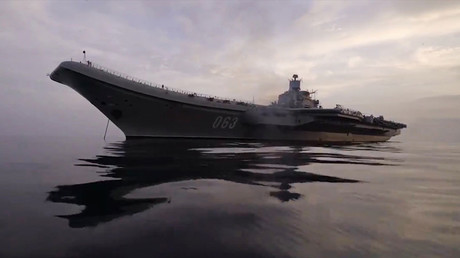
RUSSIA TODAY -- Putin says sending Admiral Kuznetsov aircraft carrier group to Syria’s shores was his own idea

Putin says sending Admiral Kuznetsov aircraft carrier group to Syria’s shores was his own idea

Putin says sending Admiral Kuznetsov aircraft carrier group to Syria’s shores was his own idea
Russian President Vladimir Putin has said that the idea to send a Russian aircraft carrier group to Syria was his own, adding that Russia does not intend to interfere in Syria’s internal affairs, but wants to deal with the terrorists.
Russia’s aircraft carrier group from the Northern Fleet inflicted significant damage to extremist groups in Syria, Putin said at a meeting with the officers who distinguished themselves during the operation in the Mediterranean near Syria’s shores.
You have fulfilled all the tasks that were given to you and inflicted significant damage to the international terrorist groups by hitting their bases, ammunition storages, equipment, and infrastructure,” he said.
The Russian military has greatly contributed to international anti-terrorist efforts and helped to create conditions for the peace talks between the Syrian government and the armed opposition,” Putin said.
The Russian president added that Russia’s goal in Syria is to stabilize the legitimate government and to “put an end to the terrorist blight.”
Our goal is to stabilize the legitimate government and strike a decisive blow to the international terrorism,” Putin said, adding that “the sooner the country [Syria] will proceed with political settlement the more chances the international community will have in putting an end to the terrorist blight on the Syrian territory.”
He went on to say that more than 4,000 militants from Russia and 5,000 from the former USSR are fighting alongside extremists in Syria, citing Russian intelligence data.
The president said that this poses a serious threat to Russia’s security and thanked the officers for doing their duty to protect the country.
The officers who took part in the operation told Putin that the aircraft carrier group was closely followed by NATO vessels, both on its way to Syria and on its way back to their Russian port, noting that “at least eight NATO warships” were around constantly whose actions were “far from friendly.”
The Russian naval group headed by the Admiral Kuznetsov aircraft carrier made headlines in 2016 when it was deployed to fight jihadists in the Middle East.
It departed from the town of Severomorsk, which is the main base of Russia’s Northern fleet, in October of last year. A month later, it carried out its first combat mission in the Mediterranean.
Its flagship aircraft carrier – manned by nearly 2,500 crew members and carrying dozens of fighter jets and helicopters – is also a missile cruiser equipped to protect itself from incoming air attacks.
The group also included the Peter the Great battle cruiser and other military ships equipped with precision weapons, as well as Kamov helicopters capable of carring out anti-submarine warfare, and search and rescue missions.

assange


At midday on Friday 5 February, 2016 Julian Assange, John Jones QC, Melinda Taylor, Jennifer Robinson and Baltasar Garzon will be speaking at a press conference at the Frontline Club on the decision made by the UN Working Group on Arbitrary Detention on the Assange case.

xmas


the way we live

MAN


THE ENTIRE 14:02' INTERVIEW IS AVAILABLE AT

RC


info@exopoliticsportugal.com

BJ 2 FEV


http://benjaminfulfordtranslations.blogspot.pt/


UPDATES ON THURSDAY MORNINGS

AT 08:00h UTC


By choosing to educate ourselves and to spread the word, we can and will build a brighter future.

bj


Report 26:01:2015

BRAZILIAN

CHINESE

CROATIAN

CZECK

ENGLISH

FRENCH

GREEK

GERMAN

ITALIAN

JAPANESE

PORTUGUESE

SPANISH

UPDATES ON THURSDAY MORNINGS

AT 08:00 H GMT


BENJAMIN FULFORD -- jan 19


UPDATES ON THURSDAY MORNINGS

AT 08:00 H GMT

PressTV News Videos